Table of Contents
Introduction
In a previous article, we explored how IoT is transforming the portable sanitation industry from the three sensor types driving the change to the shift from reactive to predictive maintenance. That article covered the industry-wide transformation. This one goes deeper.
This guide is about the specific mechanics of IoT restroom monitoring: how water level sensors, waste level sensors, and GPS sensors actually work inside a portable restroom unit, what data they produce, how that data flows into an operational dashboard, and how it triggers the maintenance actions that keep a fleet running efficiently.
For operators who have already read about why traditional operations fail and understand the principles of portable restroom fleet management, this article answers the next logical question: What does sensor-based monitoring actually look like in practice?
The answer is a system where every unit in the fleet reports its own condition water supply, waste capacity, and physical location continuously and autonomously. The operator’s job shifts from inspecting equipment to interpreting data and acting on alerts.
The Problem: Flying Blind Between Service Visits
The fundamental challenge of portable restroom operations is an information gap. From the moment a unit is deployed to a job site, event venue, or construction zone, the operator loses visibility into its condition. There is no way to know whether the water tank is running low, whether the waste tank is nearing capacity, or whether the unit has been moved until a technician physically arrives or a customer calls with a complaint.
Every unnecessary service trip costs money. A technician driving across a county to check on a unit that turns out to be fine is a wasted investment of fuel, labor, and time. But the alternative skipping the trip risks a customer arriving at a unit with no water, an overflowing waste tank, or equipment that has disappeared entirely.
This is the dilemma that manual operations cannot resolve. Fixed service schedules attempt to split the difference, but they are inherently imprecise: some units are serviced too early (wasting resources), while others develop problems between visits (risking failure). Industry data suggests that reactive maintenance responding only after a problem occurs costs two to three times more than structured preventive programs, and predictive maintenance driven by real-time sensor data reduces that cost further still.
The solution is not more frequent inspections. It is equipment that can report its own status.
Why Portable Restrooms Need Autonomous Monitoring
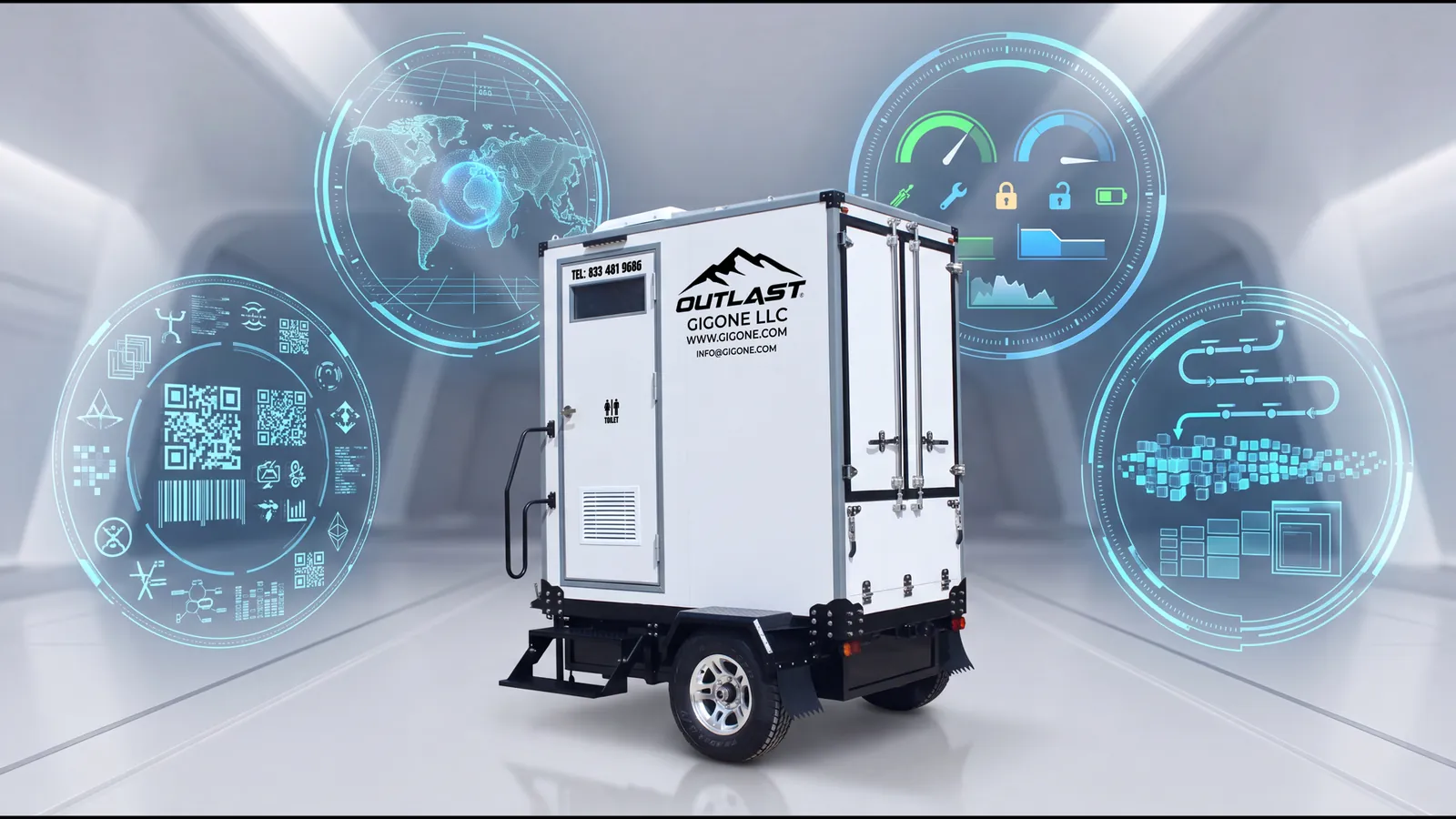
Unlike a delivery truck that returns to a depot every evening or a vending machine inside a building with power and connectivity, a portable restroom operates under conditions that make monitoring uniquely challenging:
No permanent power supply. Units deployed at construction sites, parks, and event venues typically have no access to grid electricity. Sensors must operate on battery power for weeks or months between service visits. Premium models like the Premium Mobile Oasis™ – Model AA-1P include an integrated 200W solar power system that can extend sensor battery life indefinitely in adequate sunlight, but the monitoring system must function reliably regardless of power source.
No fixed water or waste infrastructure. Clean water is filled and waste is pumped out by service technicians. Between visits, the unit’s consumable levels change based entirely on usage patterns that vary dramatically by location, event type, and season. A unit at a weekend music festival depletes water and fills waste tanks at a completely different rate than a unit at a long-term construction site.
Remote and dispersed deployment. A single operator’s fleet may be spread across dozens of locations in multiple cities. Physical inspection of every unit on a regular basis is logistically impractical and economically wasteful. The operator needs each unit to communicate its status remotely.
Regulatory accountability. The EPA sets guidelines for waste handling and disposal. OSHA standards (29 CFR 1926.51) require functional sanitation facilities at construction sites. Operators must be able to demonstrate that units are maintained to these standards and real-time monitoring data provides documentation that paper-based inspection logs cannot match.
These constraints define what portable restroom sensors must deliver: autonomous, battery-efficient, remotely transmitted data that gives operators continuous visibility without physical presence.
Water Level Sensors Preventing Service Failures Before They Happen
The most common service failure reported by portable restroom customers is simple: the unit ran out of clean water. When a handwashing sink produces no water, the unit has failed its most basic hygiene function. When a vacuum toilet system cannot flush, the unit becomes unusable entirely.
Water level sensors eliminate this failure mode by continuously measuring the remaining clean water in the fresh water tank and transmitting the reading to the operator’s dashboard.
How it works in practice. A sensor installed in the fresh water tank measures the liquid level and transmits a percentage reading for example, “Water Level: 50%.” This reading is updated at regular intervals and displayed on the IoT monitoring dashboard alongside the sensor’s metadata: Sensor Code, Status (online or offline), Signal Strength, and Battery Level.
Each sensor carries a unique identifier that links it to a specific unit in the asset registry. An operator looking at the dashboard sees not just “Water Level 50%” but “Water Level 50% on Asset #AST-20260508-000001, Premium Mobile Oasis™ – Model A-1P, deployed at [location], last reading 2 hours ago.”
What this enables:
- Threshold-based alerts. The system generates a notification when water drops below a configurable threshold for example, 30%. The operator can schedule a refill during the next planned route rather than dispatching an emergency trip.
- Usage pattern recognition. Historical water level data reveals how quickly different locations and event types consume water. A unit at a construction site with 20 workers may drop from 100% to 30% over five days, while the same model at a weekend festival may reach 30% in 36 hours. These patterns inform service scheduling.
- Model-specific insights. The Premium Mobile Oasis™ – Model AA-1P and Premium Mobile Oasis™ – Model A-1P each carry 300-liter fresh water tanks. The Flare Mobile Oasis A-1P and Pearl Mobile Oasis B-1P also carry 300 liters. The C-1P Professional Flush Portable Restroom carries 250 liters. Knowing the tank capacity and current level for each specific model enables precise refill planning a smaller tank at a high-traffic location needs service sooner than a larger tank at a low-traffic site.
- OSHA compliance documentation. At construction sites subject to 29 CFR 1926.51, operators must provide functional sanitation facilities with adequate water supply. Continuous water level monitoring provides timestamped evidence that units remained operational throughout the rental period.
Waste Level Sensors Preventing Overflow and Health Hazards
If running out of water is the most common failure, waste tank overflow is the most consequential. An overflowing portable restroom is a health hazard, an environmental violation, and a guaranteed loss of the customer relationship. It is also entirely preventable with real-time waste level monitoring.
How it works. Waste level sensors measure the fill level of the waste tank continuously, transmitting percentage readings to the dashboard for example, “Waste Level: 44%.” When the level reaches a configurable threshold, typically 80%, the system generates an alert prompting the operator to schedule pump-out service.
The sensor data is particularly valuable because it enables operators to optimize pump-out timing. Servicing a tank at 40% wastes a trip the tank had remaining capacity. Servicing at 95% risks overflow if the schedule slips by a day. Monitoring lets operators target the optimal window, maximizing the value of each service trip while maintaining a safety margin.
Tank capacities across the Gigone lineup:
| Model | Waste Tank Capacity |
|---|---|
| Premium Mobile Oasis™ – Model AA-1P | 500 L |
| Premium Mobile Oasis™ – Model A-1P | 500 L |
| Flare Mobile Oasis A-1P | 450 L |
| Pearl Mobile Oasis B-1P | 450 L |
| C-1P Professional Flush Portable Restroom | 300 L |
A 500-liter tank on a Premium model at a controlled corporate event may take weeks to reach 80%. The same 300-liter tank on a C-1P Professional at a high-traffic construction site may reach 80% in days. Sensor data captures this variation automatically, replacing fixed schedules with condition-based service timing.
The Three-Valve Solid-Liquid Separation System
Waste management in portable restrooms is more complex than a single tank being pumped out when full. Gigone’s Premium and Professional models use a proprietary solid-liquid separation waste management system with three independent discharge valves and understanding this system explains why waste level sensor data is particularly valuable for Gigone operators.
Valve 1: Filtered water discharge. Releases relatively clear liquid from the upper layer of the tank. This is the lightest, most easily processed component of the waste stream.
Valve 2: Settled sludge discharge. Releases the middle layer settled solids that have separated from the liquid above but are not fully concentrated.
Valve 3: Full solid waste discharge. Releases the concentrated solid layer at the bottom of the tank. This is the heaviest, most difficult component to process.
All three valves open: Full system discharge for complete tank evacuation during comprehensive servicing.
Additionally, a separate gray water discharge from the washbasin routes handwashing water independently of the main waste tank, reducing the load on the primary waste system and extending time between pump-outs.
This multi-valve design reduces clogging, minimizes odors, and simplifies waste handling at disposal sites. When combined with real-time waste level monitoring, operators can determine not just when to service a unit but what type of service is needed. A tank reading 80% at a low-usage site may need only a Valve 1 discharge (filtered water), while the same reading at a high-usage site may require full three-valve evacuation.
The interaction between sensor data and the three-valve system is a concrete example of the hardware-software integration advantage that distinguishes a purpose-built platform from generic fleet management software.
GPS Sensors Preventing Equipment Loss and Enabling Smart Routing
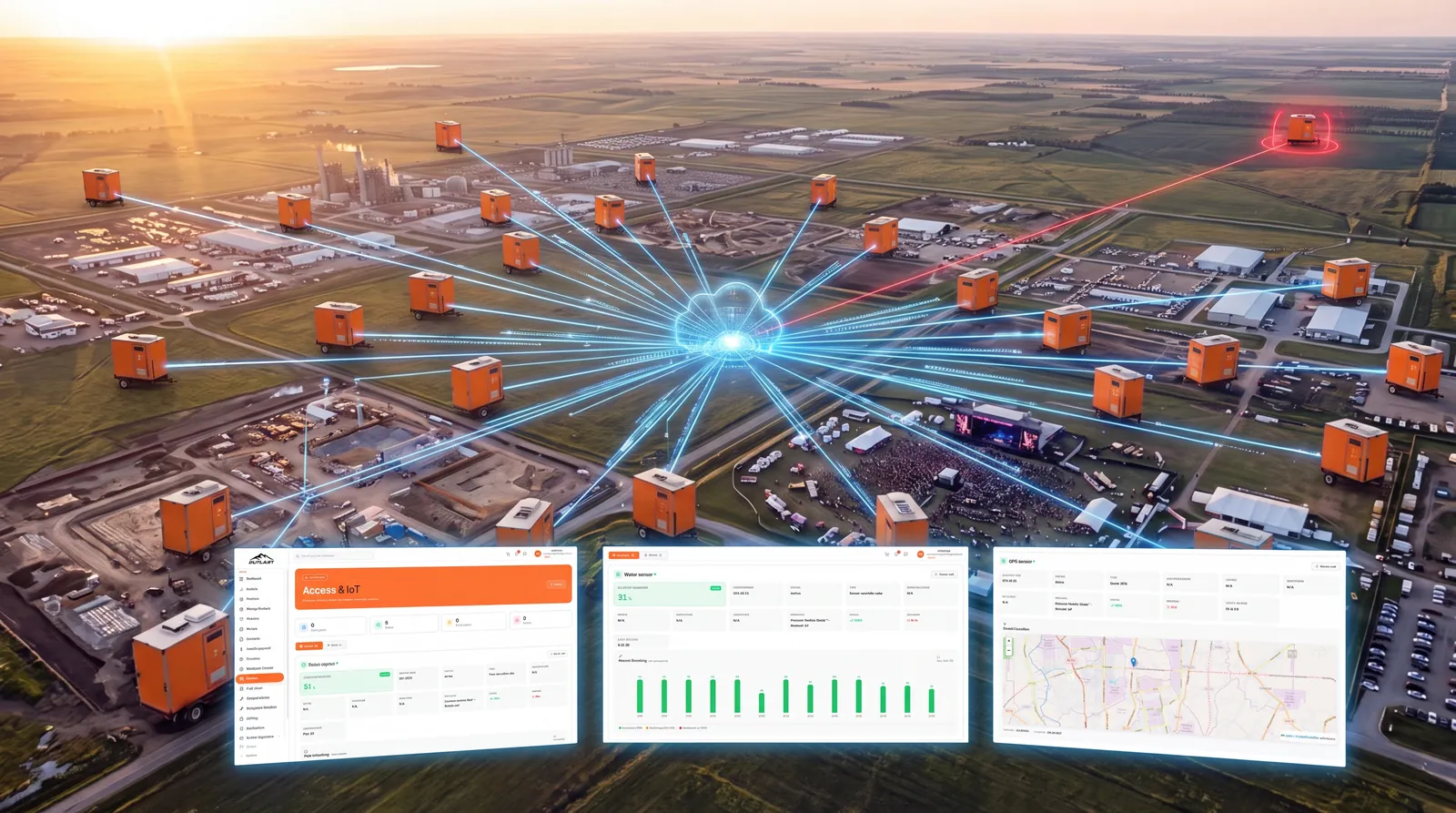
GPS tracking is often the first IoT capability operators adopt because it delivers immediate, visible value across two distinct problem areas: equipment security and service logistics.
How GPS sensors work in the GIG1 FLEET MANAGEMENT PLATFORM system. Each unit is equipped with a GPS module that transmits precise coordinates at regular intervals. The GIG1 FLEET MANAGEMENT PLATFORM dashboard displays every tracked asset on an interactive map, showing its current position alongside status information from the asset registry Asset ID, VIN, model, condition, and current rental status.
Equipment security and theft prevention. Portable restrooms are high-value assets deployed in locations without physical security. A Premium Mobile Oasis™ – Model AA-1P, with its heavy-duty frame, vacuum toilet system, air conditioning, and premium finishes, represents a significant capital investment. GPS sensors provide continuous location verification, and geofence-based alerts notify operators immediately if a unit is moved outside an expected area.
Without GPS, a stolen or relocated unit may not be discovered for weeks until a physical inventory reveals the gap or a customer calls about a unit that was supposed to be picked up. With GPS, unauthorized movement triggers an alert within minutes, enabling rapid response.
Technician route optimization. When a maintenance request is generated whether by a customer, a sensor alert, or a scheduled service cycle the GPS location of the unit flows directly into the route planning system. The technician assignment workflow in GIG1 FLEET MANAGEMENT PLATFORM uses this data to:
- Display the unit’s precise location on the route planner map.
- Calculate the distance and travel time from the nearest warehouse or the technician’s current position.
- Build multi-stop routes that group nearby service calls, minimizing total travel distance.
- Estimate arrival times for customer communication.
End-of-rental retrieval. When a rental period ends, GPS coordinates eliminate the common problem of units being moved from their original delivery location. The pickup team knows exactly where every unit is, reducing retrieval time and preventing the situation where a crew arrives at the documented address only to find the unit has been relocated across the site.
Fleet-wide visibility. At the aggregate level, the GPS map provides a real-time view of the entire fleet’s geographic distribution. Operators can see at a glance where their assets are concentrated, where gaps exist in coverage, and how service routes can be optimized across the full fleet capabilities that feed directly into the strategic analysis covered in restroom rental business analytics.
The GIG1 FLEET MANAGEMENT PLATFORM IoT Dashboard From Raw Data to Operational Action
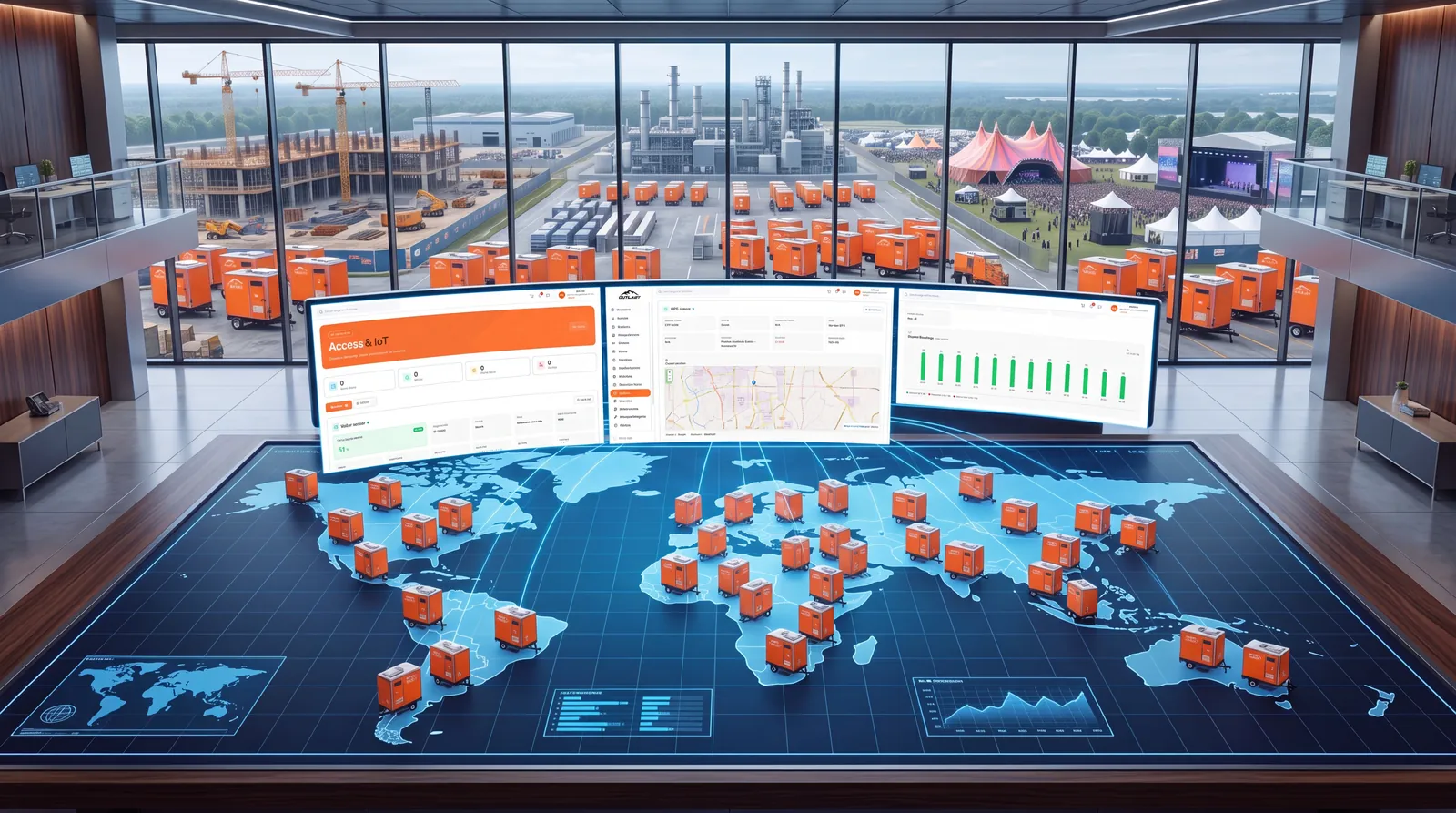
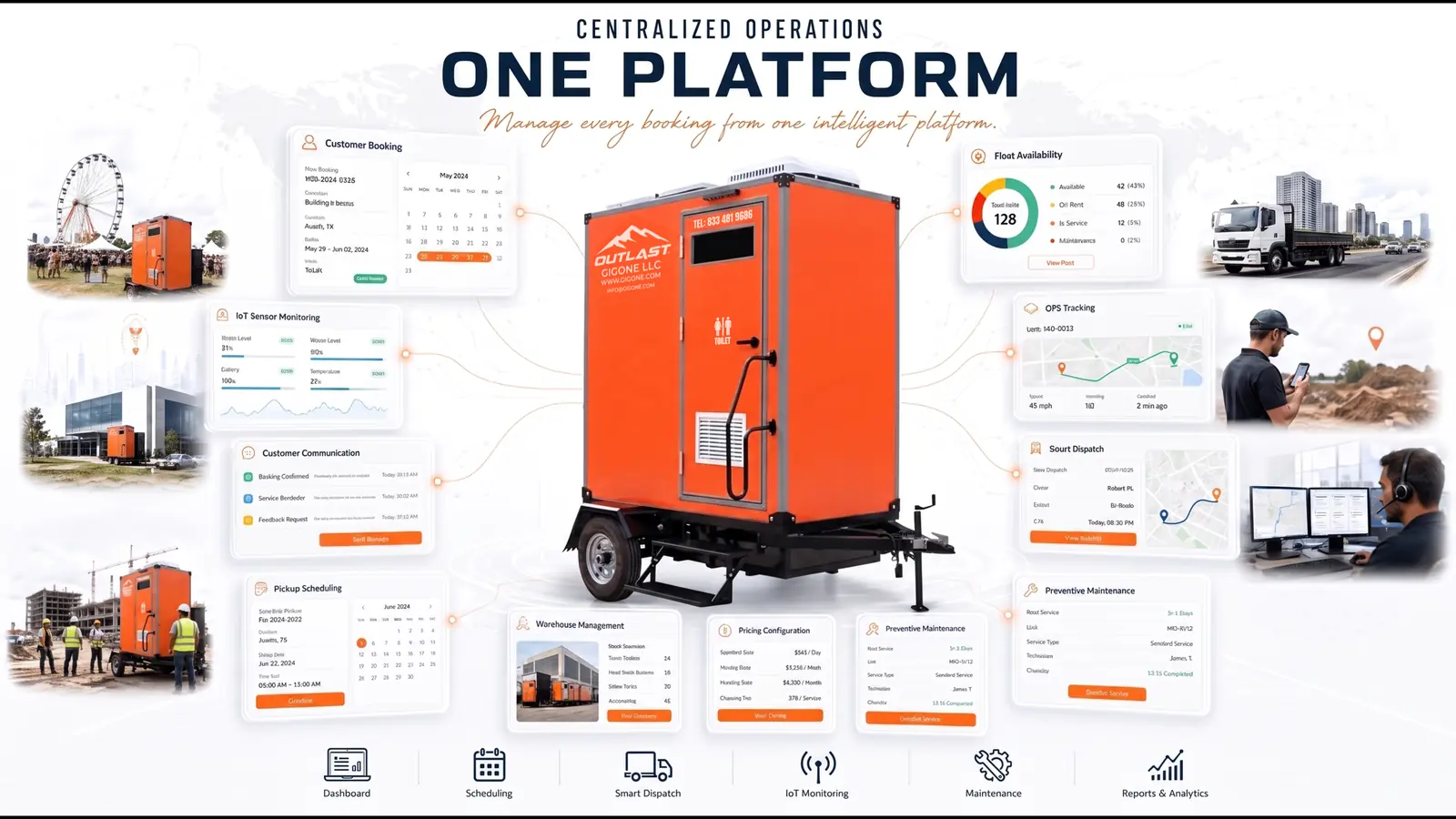
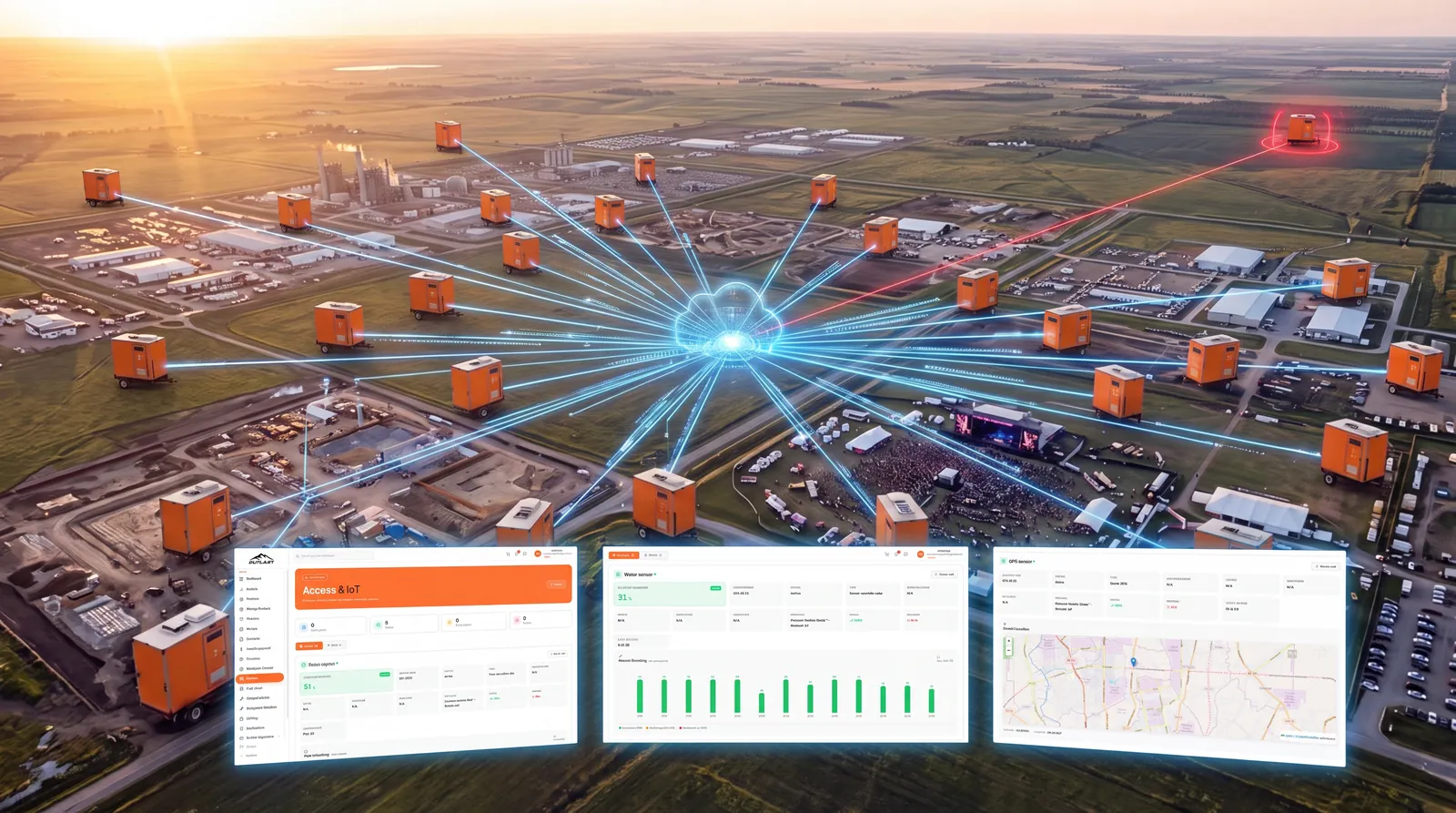
Individual sensor readings are valuable, but their full potential is realized when aggregated into a centralized dashboard that presents the fleet’s IoT status as a single, actionable view.
Dashboard overview metrics. The GIG1 FLEET MANAGEMENT PLATFORM IoT monitoring interface displays four key status cards at the top level:
| Metric | What It Shows |
|---|---|
| Total Sensors | Count of all installed sensors across the fleet |
| Online | Sensors currently connected and transmitting normally |
| Active Alerts | Ongoing alerts requiring operator attention |
| Offline | Sensors that have lost connection or have power issues |
These four numbers provide an instant health check of the entire sensor network. If the “Offline” count is rising, there may be a connectivity issue in a specific area or a batch of sensors approaching battery depletion.
Sensor-level detail. Clicking on any individual sensor opens a detailed view that includes:
- Sensor Code unique identifier linking the sensor to its unit.
- Status online, offline, or alert state.
- Type Water, Waste, or GPS.
- Location linked to the asset’s current deployed position.
- Linked Product the specific unit the sensor is installed on, identified by Asset ID and model.
- Signal Strength current cellular connectivity quality.
- Battery Level remaining power, enabling proactive battery replacement.
- Last Reading timestamp and value of the most recent data transmission.
- Reading History Charts historical trend graphs showing how levels have changed over time.
GPS sensor view. For GPS sensors specifically, the detailed view displays the asset’s precise coordinates on an interactive map, with the ability to zoom, pan, and overlay other fleet assets for geographic context.
Alert management. The Alerts tab stores logs and detailed messages for system events that require attention sensor threshold breaches, devices going offline, security alerts from geofence violations, and maintenance triggers. Each alert carries a priority level (critical, warning, informational) that helps operators triage their response.
The dashboard transforms IoT monitoring from a technical capability into an operational workflow. An operator does not need to understand sensor protocols or data formats they see water levels, waste levels, locations, and alerts presented in a format designed for immediate action.
How Sensor Data Triggers Maintenance Workflows
The connection between sensor monitoring and maintenance action is where IoT delivers its highest-value impact. In the GIG1 FLEET MANAGEMENT PLATFORM, sensor data does not just display on a dashboard it flows directly into the maintenance management system, creating a seamless path from detection to resolution.
Sensor alert → Maintenance trigger. When a sensor reading crosses a configured threshold water level below 30%, waste level above 80%, GPS anomaly detected, or sensor offline the system generates an alert that appears in both the IoT dashboard and the maintenance workflow.
Partner notification. The operator (GIG1 FLEET MANAGEMENT PLATFORM Partner) receives the alert via the dashboard notification system and email. The alert includes the specific unit, location, sensor reading, and recommended action.
Route planner activation. From the alert, the partner opens the Route Planner, which automatically displays:
- The unit’s current GPS location on the map.
- Available technicians and their current positions.
- Distance and estimated travel time from each available starting point (warehouse or technician location).
Technician assignment and dispatch. The partner selects the optimal technician based on proximity and availability, and the system calculates the service route including distance, travel time, and number of stops if multiple units need service in the same area.
Maintenance plan creation. One click creates the Maintenance Plan, which dispatches the assignment to the technician and sends an automated “Maintenance Job Notification” email to the customer, informing them that service has been scheduled.
Status tracking. The maintenance job moves through a tracked workflow: PENDING → IN PROGRESS → COMPLETED. The partner can monitor all active jobs, see assigned staff, and track completion in real time.
This end-to-end flow from sensor reading to customer notification typically takes minutes rather than the hours or days that manual discovery and dispatch require. More importantly, it happens before the customer experiences a problem, transforming the operator’s reputation from reactive to proactive.
Sensor Reliability and Standards
Sensors deployed in portable restrooms operate under conditions that consumer electronics would never survive. Reliability in this environment is not optional a sensor that fails silently creates worse outcomes than having no sensor at all, because the operator assumes monitoring is active when it is not.
Battery life and power management. Field sensors must operate for months on battery power alone. Low-power sensor designs combined with efficient transmission protocols (LTE-M, NB-IoT) minimize energy consumption while maintaining regular data updates. The GIG1 FLEET MANAGEMENT PLATFORM dashboard continuously monitors battery level for every sensor, enabling proactive replacement before power failure.
For units equipped with solar power such as the Premium Mobile Oasis™ – Model AA-1P with its integrated 200W solar system sensor batteries can be maintained indefinitely under normal sunlight conditions, reducing one of the key maintenance touchpoints for the IoT system itself.
Signal strength monitoring. Cellular connectivity varies by location, and a sensor deployed at a remote construction site may have weaker signal than one at an urban event venue. The dashboard displays signal strength for every sensor, and connectivity issues are flagged before they result in data gaps. If a sensor consistently shows weak signal at a particular location, the operator can adjust transmission frequency or investigate alternative connectivity options.
Environmental durability. Sensors must withstand temperature extremes (from freezing winter conditions to summer heat inside an enclosed unit), humidity, vibration during transport, and physical handling during service operations. Industrial-grade sensors rated for outdoor deployment are essential consumer-grade IoT devices will fail in this environment.
IEEE and industry protocols. The Institute of Electrical and Electronics Engineers (IEEE) maintains standards for IoT communication protocols and data security. Operators evaluating smart restroom platforms should verify that sensor systems follow recognized security practices for data transmission and storage, particularly given that GPS location data can reveal customer site locations.
EPA compliance support. While IoT sensors do not directly enforce EPA waste handling standards, the continuous monitoring data they generate waste levels over time, pump-out frequency, discharge records provides documentation that supports compliance during audits. This digital trail is significantly more reliable than paper-based service logs.
Conclusion
IoT restroom monitoring is not an abstract technology concept it is a specific set of sensors producing specific data that drives specific operational actions. Water level sensors prevent the most common service failure. Waste level sensors prevent the most consequential one. GPS sensors prevent equipment loss and enable efficient routing.
The three-valve solid-liquid separation system in Gigone’s restroom units adds a dimension of waste management intelligence that generic monitoring cannot provide knowing not just that a tank is full, but how to service it most efficiently based on the waste composition.
The GIG1 FLEET MANAGEMENT PLATFORM IoT dashboard aggregates this data into a single operational view, and the direct connection between sensor alerts and maintenance workflows closes the loop from detection to resolution. The result is a fleet that reports its own condition, triggers its own service, and generates the documentation that compliance requires all without a technician physically visiting a unit to check on it.
For operators already managing their fleets through GIG1 FLEET MANAGEMENT PLATFORM’s smart restroom management platform, IoT monitoring is the intelligence layer that transforms the platform from a management tool into a predictive operations system. For operators still evaluating the technology, the question is not whether sensors work the data is clear. The question is whether continuing to operate without them is a competitive position they can afford to maintain.
The next step in the GIG1 FLEET MANAGEMENT PLATFORM ecosystem is understanding how sensor data flows into automated maintenance management workflows the subject of Article #4 in this series.
Frequently Asked Questions
Why do portable restrooms need IoT sensors?
Because they are deployed in remote locations without fixed infrastructure or human supervision. Sensors provide real-time visibility into water levels, waste capacity, and location enabling proactive service instead of relying on scheduled inspections or customer complaints. Without sensors, the operator has zero data about unit condition between service visits.
How do waste level sensors prevent overflow?
Waste level sensors continuously monitor tank capacity and transmit percentage readings to the operator’s dashboard. When levels reach a configurable threshold typically 80% the system generates an alert prompting the operator to dispatch pump-out service before overflow occurs. This eliminates the risk of both premature service (wasting a trip on a half-full tank) and late service (risking overflow).
How reliable are portable restroom IoT sensors?
Modern field sensors are battery-powered, weather-resistant, and designed for harsh outdoor environments including temperature extremes, humidity, and vibration during transport. The GIG1 FLEET MANAGEMENT PLATFORM dashboard continuously monitors signal strength and battery level for every sensor, flagging potential issues before they cause data gaps. Units with integrated solar power can maintain sensor batteries indefinitely.
What is the three-valve waste discharge system?
Gigone’s portable restroom units use a solid-liquid separation system with three independent discharge valves. Valve 1 releases filtered water from the upper tank layer, Valve 2 releases settled sludge from the middle layer, and Valve 3 releases concentrated solid waste from the bottom. A separate gray water line handles washbasin drainage independently. This system reduces clogging, minimizes odors, and enables more efficient waste processing.
How does sensor data connect to maintenance scheduling?
In the GIG1 FLEET MANAGEMENT PLATFORM, sensor alerts flow directly into the maintenance workflow. When a threshold is crossed low water, high waste, GPS anomaly, or sensor offline the system notifies the operator, who can open the route planner, assign a technician based on proximity, calculate the optimal service route, and dispatch the job with a single workflow. The customer receives an automated email confirming that service has been scheduled.