Table of Contents
Introduction
The Internet of Things (IoT) has transformed industries across the global economy. Agriculture uses soil sensors to optimize irrigation. Logistics companies track every container in real time. Waste management operators monitor bin fill levels to route collection trucks efficiently. Manufacturing plants predict equipment failure before it happens.
Portable sanitation has been a latecomer to this transformation but that is changing rapidly.
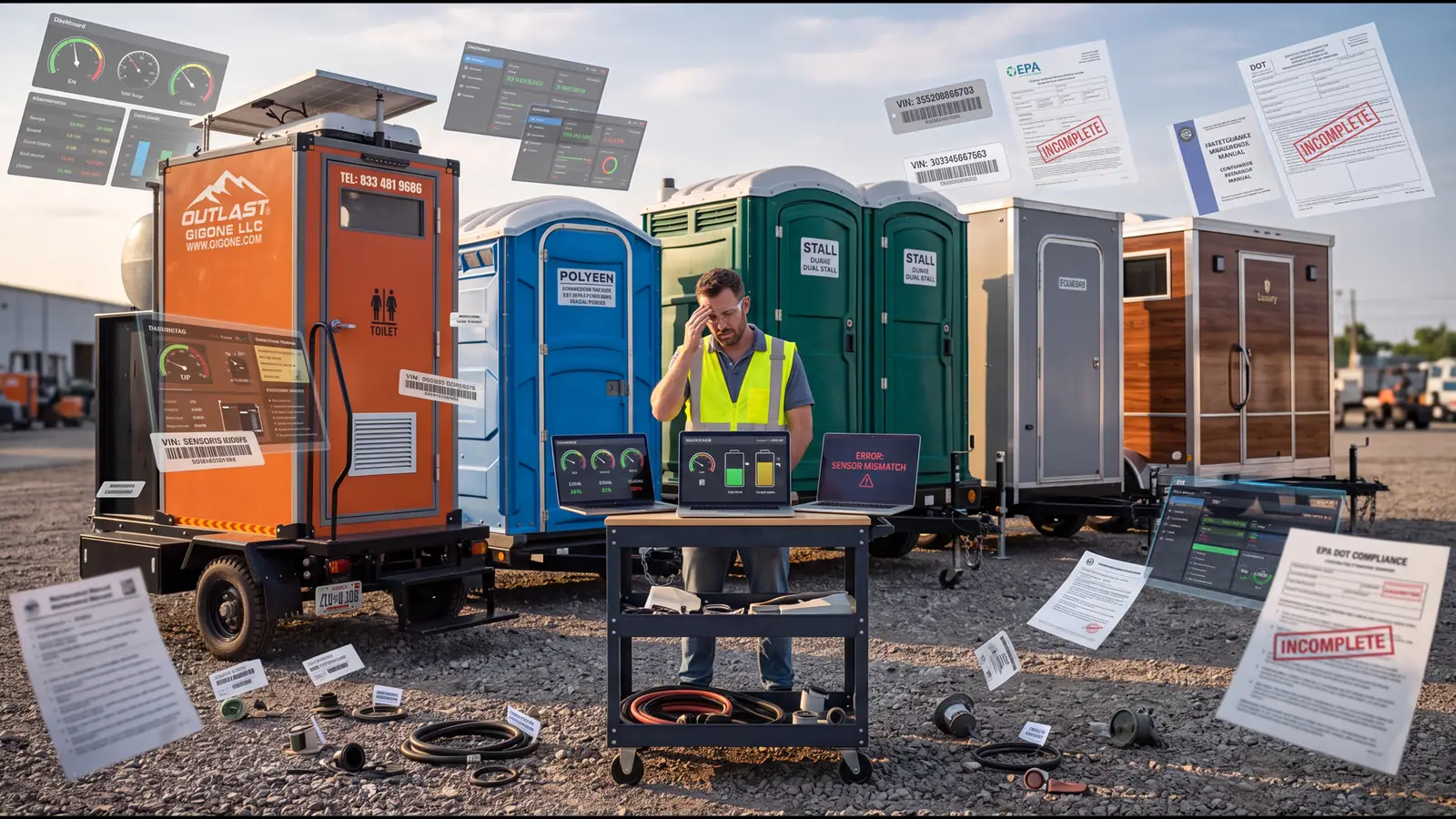
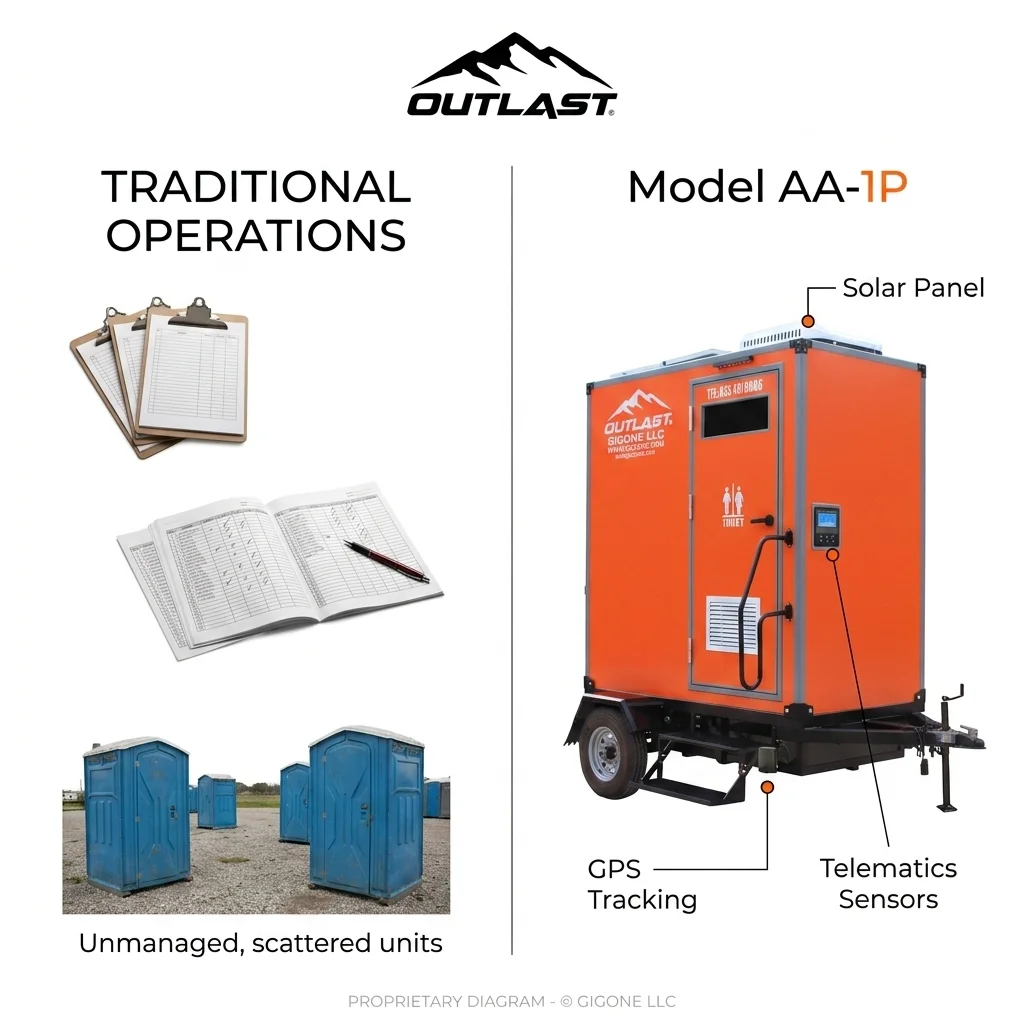
For decades, portable restroom operators managed their fleets without a single data point between service visits. A unit was delivered, it sat at a job site or event, and no one knew its condition until a technician arrived for a scheduled inspection or until a customer called to report a problem. This information gap is what made portable restroom management problems like reactive maintenance and equipment loss so persistent across the industry, as we explored in Why Traditional Portable Restroom Operations Are Inefficient.
IoT technology is closing that gap. Sensors embedded in restroom units now transmit real-time data on water levels, waste tank capacity, and GPS location giving operators the visibility they need to shift from reactive guesswork to proactive, data-driven operations.
This article examines how IoT is transforming the portable sanitation industry, the three sensor types driving the change, the shift from reactive to predictive maintenance, and what operators need to know about adopting smart restroom technology.

The IoT Revolution in Field Services
IoT is not a new concept in field services. The industries most similar to portable sanitation have been deploying connected sensors for years with measurable results.
Agriculture uses IoT sensors to monitor soil moisture, temperature, and nutrient levels across thousands of acres. Farmers receive real-time alerts when irrigation is needed, reducing water consumption by up to 30% while improving crop yields.
Logistics and trucking have integrated GPS tracking, temperature sensors, and fuel monitoring into fleet management systems. Real-time visibility into asset location and condition has become a competitive requirement rather than a differentiator.
Waste management companies now deploy fill-level sensors in commercial dumpsters and collection containers. Instead of running fixed routes regardless of actual fill status, operators dispatch trucks only when containers are nearing capacity reducing fuel costs, labor hours, and vehicle wear.
What these industries share is a common pattern: sensors collect data, software interprets it, and operators act on it before problems occur. Portable sanitation is following the same pattern, and three converging trends are accelerating adoption:
Lower sensor costs. Industrial-grade IoT sensors that cost hundreds of dollars a decade ago are now available at a fraction of the price, making per-unit sensor deployment economically viable for fleets of any size.
Better battery technology. Field sensors must operate for months without external power. Modern battery technology, combined with low-power sensor designs, enables reliable operation across extended deployment cycles.
Ubiquitous connectivity. Cellular IoT networks (LTE-M, NB-IoT) provide reliable coverage even in remote areas where portable restrooms are commonly deployed construction zones, parks, festival grounds, and disaster response sites.
The result is that smart sanitation technology once a niche concept is becoming accessible to mainstream portable restroom operators.
Why Portable Sanitations Needs IoT Sensors
The need for IoT in portable sanitation arises from a fundamental characteristic of the industry: restroom units are deployed in locations without fixed infrastructure, often far from any central monitoring system.
A typical portable restroom at a construction site, festival, or park has:
- No permanent power connection the unit must operate autonomously on batteries or solar power.
- No fixed water supply clean water must be filled at the depot or on-site by a technician.
- No real-time human supervision between service visits, no one from the operator’s team sees the unit.
This makes the portable restroom a uniquely difficult asset to manage. Unlike a truck that returns to a depot daily, or a building with permanent sensors and staff, a portable restroom must report its own condition or the operator has no way to know it.
Beyond the operational challenge, customer expectations are rising. Event organizers, construction site managers, and facility operators increasingly expect clean, well-stocked, and fully functional restrooms throughout the rental period. A unit that runs out of water, overflows, or goes missing creates not just a service ticket but a reputational failure that can cost future business.
Regulatory requirements add another layer. The EPA sets guidelines for waste handling and disposal, and operators are responsible for documenting proper treatment. Without monitoring, compliance is a matter of trust rather than verification.
These factors autonomous operation, rising expectations, and regulatory accountability create the case for IoT sanitation technology as a practical necessity, not a luxury upgrade.
Sensor Type 1: Water Level Sensors Solving Service Failures
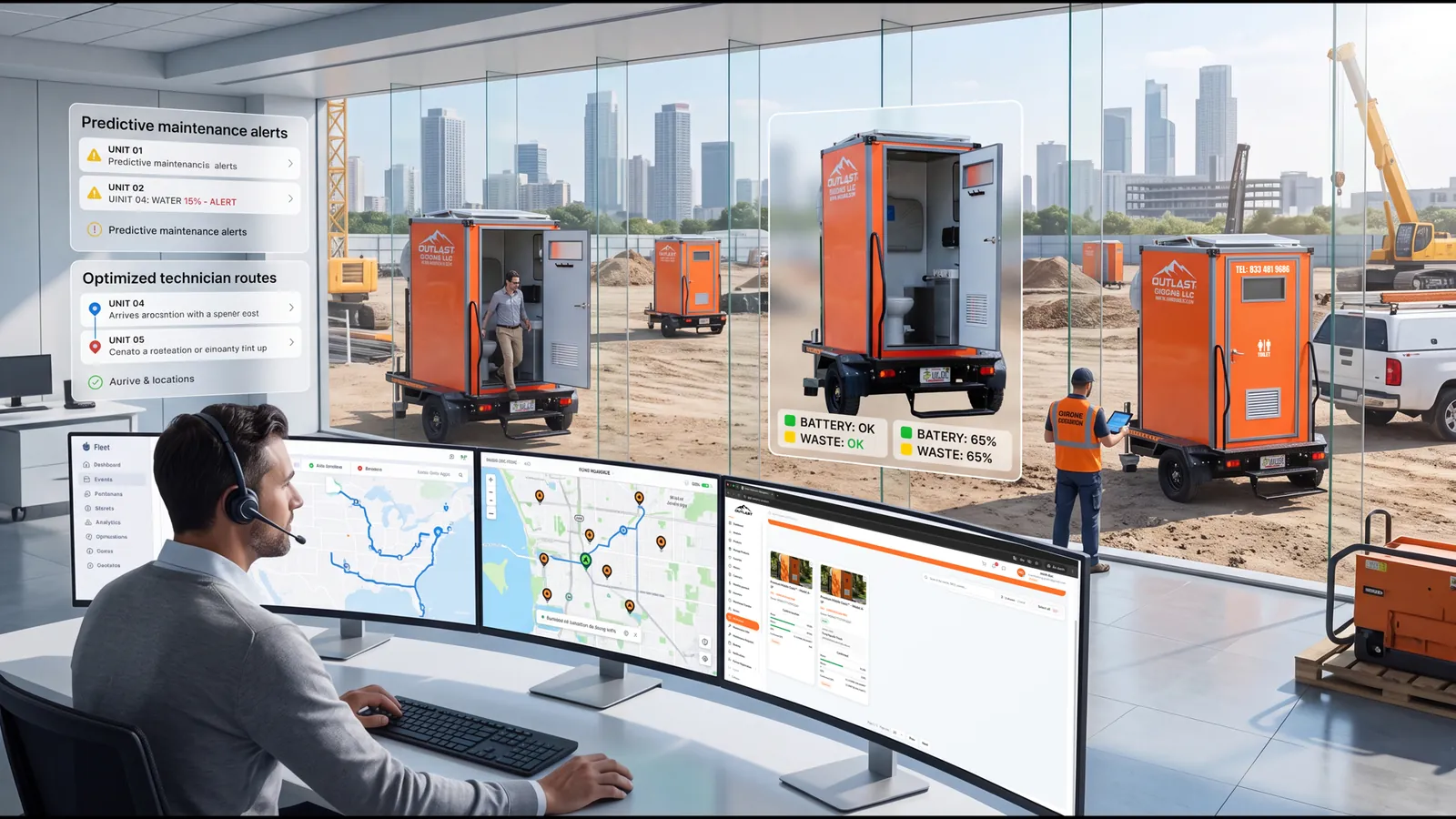
The most common service failure in portable restroom operations is simple: a unit runs out of clean water. A handwashing sink without water is a hygiene failure. A vacuum toilet that cannot flush becomes unusable. And because no one knows the water level between service visits, the first sign of a problem is a customer complaint.
How water level sensors work. These sensors continuously measure the remaining clean water in the fresh water tank, transmitting readings in real time to the platform dashboard. An operator sees, for example, “Water Level: 50%” for a deployed unit and can schedule a refill well before the tank runs dry.
In the GIG1 FLEET MANAGEMENT PLATFORM IoT monitoring system, each water sensor carries a unique identifier Sensor Code, Status, Signal Strength, and Battery Level making it possible to track sensor health independently of the unit it monitors.
What water level sensors prevent:
- “No water” complaints from customers during events or at construction sites.
- Emergency water refill dispatches that cost fuel and labor but could have been bundled with scheduled service.
- Hygiene violations at regulated job sites where handwashing facilities must remain operational under OSHA standards (29 CFR 1926.51).
For operators managing premium models such as the Premium Mobile Oasis™ – Model AA-1P (with its 300-liter fresh water tank) or the C-1P Professional Flush Portable Restroom (250-liter tank), knowing real-time water levels transforms maintenance from a calendar-based check to a condition-based decision.
Sensor Type 2: Waste Level Sensors Solving Overflow and Health Hazards
If water depletion is the most common service failure, waste tank overflow is the most consequential. An overflowing portable restroom is not just an inconvenience it is a health hazard, a regulatory violation, and a guarantee that the customer will not book again.
How waste level sensors work. These sensors monitor the waste tank fill level continuously. When the tank reaches a configurable threshold typically 80% capacity the system generates an alert, prompting the operator to dispatch pump-out service before an overflow occurs.
In the GIG1 FLEET MANAGEMENT PLATFORM ecosystem, waste level data is particularly valuable because Gigone’s units are equipped with a proprietary solid-liquid separation waste management system using three independent discharge valves:
- Valve 1: Filtered water discharge releases relatively clear liquid from the upper layer of the tank.
- Valve 2: Settled sludge discharge releases the middle layer of settled solids.
- Valve 3: Full solid waste discharge releases the concentrated solid layer at the bottom of the tank.
- All 3 valves open: Full system discharge for complete tank evacuation.
- Separate gray water discharge: The washbasin has its own drain line, reducing the load on the main waste tank.
This three-valve system reduces clogging, minimizes odors, and simplifies waste handling at disposal sites. When paired with real-time waste level monitoring, operators can schedule pump-out service at the optimal time before the tank reaches capacity, but not so early that service trips are wasted on partially filled tanks.
Models like the Premium Mobile Oasis™ – Model AA-1P and Premium Mobile Oasis™ – Model A-1P each carry a 500-liter waste tank, while the Flare Mobile Oasis A-1P and Pearl Mobile Oasis B-1P have 450-liter tanks. Knowing exact fill levels for each model enables precise service scheduling.
Real-world impact: Operators using waste level monitoring typically reduce unnecessary service trips by 20–30%, according to early industry adoption data. Fewer trips means lower fuel costs, less labor, and reduced vehicle wear all while actually improving service reliability.
Sensor Type 3: GPS Sensors Solving Lost Equipment and Poor Routing
Equipment loss is one of the most expensive problems in portable sanitation, as we detailed in Why Traditional Portable Restroom Operations Are Inefficient. GPS sensors address this directly and they also enable a second benefit that operators often underestimate: efficient route planning.
How GPS sensors work. Each unit is equipped with a GPS module that transmits precise coordinates to the platform. On the GIG1 FLEET MANAGEMENT PLATFORM dashboard, every asset appears on an interactive map, showing its current location, status, and sensor readings at a glance.
GPS sensors solve three problems:
- Theft and unauthorized movement detection. If a unit is moved outside a predefined geofence, the system triggers an alert. The operator knows immediately not weeks later during a physical inventory.
- Technician route optimization. When a maintenance request comes in, the route planner uses GPS data to calculate the most efficient service route. The system selects the nearest available technician, calculates travel distance and time, and builds a multi-stop route that minimizes fuel and labor costs.
- End-of-rental retrieval. When a rental period ends, GPS pinpoints the exact location of every unit scheduled for pickup. No more hunting for units that were moved during the rental.
In the GIG1 FLEET MANAGEMENT PLATFORM system, GPS sensors display precise coordinates on an interactive map, with real-time location updates. Combined with the digital asset registry (Asset ID, VIN, Serial Number), GPS tracking creates the foundation for full portable restroom fleet management visibility.
From Reactive to Predictive Maintenance
The most significant operational shift enabled by IoT is the transition from reactive maintenance to predictive maintenance. These are not just different approaches they represent fundamentally different business models.
| Approach | Trigger | Cost Profile | Customer Experience |
|---|---|---|---|
| Reactive | Customer complaint or breakdown | Highest: emergency dispatch + premium parts | Worst: failure occurs before response |
| Preventive | Fixed calendar schedule | Moderate: regular visits, some waste | Better: fewer failures, but still gaps |
| Predictive | Real-time sensor thresholds | Lowest: service only when needed | Best: problems solved before noticed |
Most portable sanitation operators today operate at Level 1 or Level 2. They either wait for something to break (reactive) or run service on a fixed schedule regardless of actual condition (preventive).
IoT sensors make Level 3 predictive maintenance achievable. The system monitors thresholds continuously:
- Water level below 30% → Schedule refill before next complaint.
- Waste level above 80% → Dispatch pump-out before overflow.
- GPS anomaly detected → Investigate unauthorized movement.
- Sensor offline → Check battery or connectivity before data gap becomes critical.
In the GIG1 FLEET MANAGEMENT PLATFORM, these alerts flow directly into maintenance workflows. A partner receives a notification, opens the route planner, assigns a technician, and creates a maintenance plan all triggered by sensor data rather than a customer phone call.
The result is a maintenance operation that spends less money while delivering better service a rare combination in any industry.
The Data Layer Turning Sensors Into Decisions
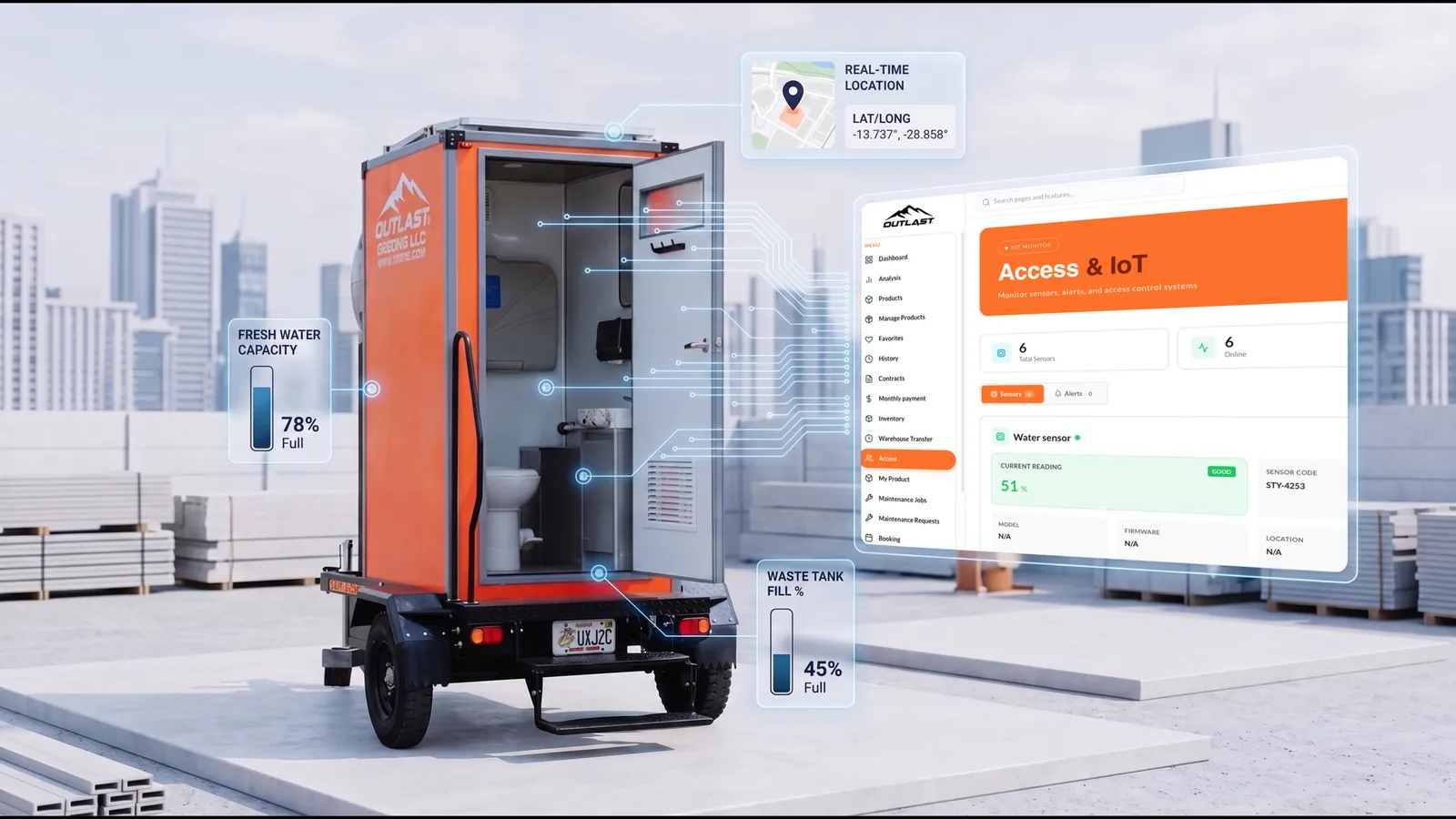
Individual sensor readings are useful, but their real value emerges when aggregated into dashboards that reveal patterns across the entire fleet.
Real-time dashboards provide a single view of all sensor status: total sensors online, active alerts, offline devices, and critical warnings. An operator can see at a glance whether the fleet is healthy or whether specific units need immediate attention.
Historical data reveals trends that individual readings cannot. Which models generate the most alerts? Which locations have the highest water consumption rates? Are waste levels rising faster during summer events than spring construction projects? These patterns inform strategic decisions about fleet composition, deployment planning, and maintenance staffing.
Geographic analysis already a feature in the GIG1 FLEET MANAGEMENT PLATFORM analytics module combines sensor data with booking data to identify where demand is highest and where service capacity is strained, as explored in Restroom Rental Business Analytics.
The ROI of IoT adoption becomes visible at the aggregate level:
- 20–30% reduction in unnecessary service trips sensors prevent both premature service (wasted) and late service (emergency).
- Reduced equipment loss GPS tracking prevents theft and simplifies retrieval.
- Lower maintenance costs predictive maintenance costs significantly less than reactive, per industry benchmarks.
- Higher customer satisfaction fewer service failures and proactive communication build trust.
Industry Standards for IoT in Sanitation
As IoT adoption grows in portable sanitation, several standards frameworks are relevant for operators evaluating smart restroom technology:
IEEE IoT protocols and security standards. The Institute of Electrical and Electronics Engineers maintains standards for IoT communication protocols and security practices. Operators should ensure that any connected system they adopt follows recognized data security practices.
EPA water quality monitoring requirements. While portable restrooms are not subject to continuous water quality monitoring, the EPA guidelines for waste handling and discharge (including the proper operation of solid-liquid separation systems) apply throughout the rental lifecycle.
Battery and environmental durability. Sensors deployed in portable restrooms must withstand outdoor conditions temperature extremes, humidity, vibration during transport, and physical handling during service. Industrial-grade sensors rated for outdoor deployment are essential for reliable operation.
Connectivity requirements. Cellular IoT networks (LTE-M, NB-IoT) are the most practical connectivity option for portable restrooms deployed across dispersed locations. Operators should verify coverage in their service areas before committing to a sensor deployment.
What This Means for Operators
IoT technology in portable sanitation is no longer a futuristic concept. It is available now, at price points that make per-unit sensor deployment economically viable, and it is already delivering measurable results for early adopters.
For operators evaluating the shift to smart restroom technology, a practical starting point is:
Start with GPS tracking. It is the most affordable sensor type and delivers immediate value equipment loss prevention, retrieval efficiency, and technician route optimization.
Add water and waste sensors incrementally. Deploy on high-value or high-usage units first (premium models at long-term events), measure the impact on service frequency, and scale to the full fleet as ROI is demonstrated.
Choose an integrated platform. Sensors alone are not enough the value comes from software that interprets sensor data and triggers action. Platforms like GIG1 FLEET MANAGEMENT PLATFORM, which integrate IoT monitoring with asset management, maintenance workflows, booking, and analytics, deliver the full benefit of connected operations.
The smart sanitation technology transition is underway across the industry. Operators who adopt it early will benefit from lower costs, better customer retention, and a data advantage that grows stronger over time. Those who wait will find themselves competing against operators who know exactly where every unit is, what condition it is in, and when it will need service next.
Conclusion
IoT is transforming the portable sanitation industry by replacing guesswork with data. Three sensor types water level, waste level, and GPS address the most costly and persistent problems operators face: service failures, health hazards, equipment loss, and inefficient routing.
The shift from reactive to predictive maintenance enabled by these sensors represents the most significant operational improvement available to portable restroom operators today. When combined with an integrated platform that turns sensor data into actionable maintenance workflows, the result is a fleet that costs less to run and delivers better service.
This transformation is not hypothetical. The sensors exist. The platforms exist. The early adoption data shows measurable ROI. The question for operators is no longer whether IoT will change the portable sanitation industry it is how quickly they will be part of that change.
The next step is understanding how IoT sensors integrate with a complete smart restroom management platform the subject of our pillar guide: What Is a Smart Restroom Management Platform?. And for a deep dive into the specific IoT monitoring capabilities, see IoT Restroom Monitoring: How Smart Sensors Track Water, Waste & Location.
Frequently Asked Questions
What IoT sensors are used in portable restrooms?
Three main types: water level sensors that track clean water supply to prevent “no water” failures, waste level sensors that monitor tank capacity to prevent overflow, and GPS sensors that track unit location to prevent loss and enable efficient route planning.
How does IoT reduce portable restroom maintenance costs?
By enabling predictive maintenance. Sensors alert operators when water levels drop or waste tanks near capacity before failures occur. This reduces emergency service dispatches (which cost 2–3x more than scheduled visits) by 20–30% while actually improving service reliability.
Is IoT adoption expensive for small portable restroom operators?
GPS tracking is the most affordable entry point, with sensors available at consumer-electronics price points. Water and waste sensors can be added incrementally as ROI is demonstrated on initial deployments. Many operators start with GPS on their full fleet and add level sensors on high-usage units first.
Do portable restroom IoT sensors need external power?
No. Modern field sensors are battery-powered and designed for months of autonomous operation. Models equipped with solar panels, such as the Premium Mobile Oasis™ – Model AA-1P with its integrated 200W solar system, can maintain sensor power indefinitely in adequate sunlight conditions.
What happens if a sensor loses connectivity?
The GIG1 FLEET MANAGEMENT PLATFORM dashboard displays sensor status including Signal Strength and Battery Level. If a sensor goes offline, the system flags it for investigation. Operators can schedule a connectivity check during the next scheduled service visit, minimizing disruption while maintaining visibility.