

Table of Contents
Introduction
Every portable restroom business reaches a point where the tools that built it can no longer run it. A whiteboard, a spreadsheet, and a sharp memory are enough to manage ten units serving one county. They are not enough to manage fifty units moving across multiple cities, each with its own service schedule, rental contract, and compliance paperwork.
The discipline that bridges that gap has a name borrowed from logistics and trucking: portable restroom fleet management.
Fleet management is not a single piece of software or a one-time decision. It is a structured way of tracking, maintaining, deploying, and optimizing every unit a business owns so that capital is not sitting idle, equipment is not going missing, and customers are not waiting on a delivery that never arrives. In a previous article, we examined why traditional portable restroom operations are inefficient and the five problems that manual processes create. This guide takes the next step: it explains the framework that solves those problems.
This article defines fleet management, explains how it applies specifically to the portable sanitation industry, breaks down its four core pillars, and identifies the metrics every operator should be tracking whether they manage a fleet of twenty units or two hundred.

What Is Fleet Management?
Fleet management is the coordinated process of overseeing the entire lifecycle and daily operation of a group of physical assets. The concept originated in industries where mobile equipment is the core of the business trucking, logistics, construction, and waste collection and where knowing the location, condition, and productivity of every asset directly determines profitability.
At its foundation, fleet management answers four questions about every asset a business owns:
- Where is it? Location and movement tracking.
- What state is it in? Condition, availability, and service status.
- How hard is it working? Utilization and revenue contribution.
- Is it compliant? Registration, certification, and documentation.
A freight company applies these questions to trucks. A construction firm applies them to excavators and generators. A waste management company applies them to collection containers and vehicles. The principles are identical. What changes from one industry to the next are the specific assets, the regulatory environment, and the operational details.
Portable sanitation is simply the newest field service industry to adopt these same principles and it brings a unique set of challenges that generic fleet management tools were never designed to handle.
Why Fleet Management Looks Different in Portable Sanitation
A portable restroom is not a truck. It does not have a driver who reports its location at the end of a shift. It does not return to a depot every night. Once deployed, a unit may sit at a remote job site, an event venue, or a construction zone for days or weeks without anyone from the business physically seeing it.
This creates challenges that distinguish portable restroom fleet management from traditional vehicle fleet management:
Assets are stationary but distributed. Unlike a truck that moves and returns, a portable restroom is delivered, sits in one place, and is later retrieved. The fleet is scattered across many locations simultaneously, often without permanent infrastructure or connectivity.
Service is consumable-driven, not mileage-driven. A truck is serviced based on miles traveled. A portable restroom is serviced based on usage how full the waste tank is, how much clean water remains, and how many people have used it since the last visit.
The product is regulated as a vehicle. Trailer-mounted units travel on public roads, which means they fall under DOT regulations and require valid VIN registration adding a compliance dimension that a standalone restroom unit would not have.
Customer experience is tied to the asset’s condition in real time. A truck with a worn tire still completes its delivery. A portable restroom that has run out of water or overflowed has failed its customer the moment that happens and the operator may not know until a complaint arrives.
These differences are why purpose-built fleet management has become essential for the industry. The four pillars below form its foundation.
Pillar 1: Fleet Visibility
Suggested image content: Dashboard-style map with restroom unit icons across construction sites, event venues, and service yard. Show status labels: Available, In Use, Maintenance, In Transit.
Fleet visibility means knowing, at any moment, where every unit is and what condition it is in. It is the foundation on which every other pillar is built because no operator can optimize, maintain, or report on assets they cannot see.
In practice, fleet visibility requires two components:
GPS location tracking. Each unit’s position is recorded and displayed on a map in real time. This eliminates the most common asset failure in the industry units that are moved, misplaced, or simply forgotten. When a crew relocates a unit to cover a last-minute request, GPS ensures the change is captured automatically rather than depending on someone remembering to update a spreadsheet.
A digital asset registry. Every unit is entered into a centralized system with a unique identifier, model, serial number, and VIN. This registry is the single source of truth for the fleet, replacing the fragmented mix of spreadsheets, notebooks, and institutional memory that most operators rely on.
Together, these components answer a question that paper-based operations often cannot: Where is unit #37 right now, and is it available, deployed, in maintenance, or in transit?
Real-time status visibility Available, In Use, Maintenance, In Transit turns the fleet from an abstraction into something an operator can actually manage. The deeper mechanics of this capability are covered in our guide to portable restroom asset tracking.
Pillar 2: Utilization Optimization
Suggested image content: Formula graphic: “Utilization Rate = Time Rented ÷ Total Available Time”. Include example: 30 rented units ÷ 50 available units = 60% utilization.
A portable restroom only earns money when it is rented. Every hour a unit sits idle in a yard is an hour of wasted capital and most operators have no idea how much of their fleet is idle at any given time.
Utilization rate is the metric that exposes this. It is calculated simply:
Utilization Rate = Time Rented ÷ Total Available Time
An operator who owns 50 units but consistently rents only 30 is running at 60% utilization. The other 20 units represent capital that has been spent but is not generating return. Without tracking, this gap is invisible the business feels busy, the trucks are moving, and no one notices that two out of five units are doing nothing.
Utilization optimization uses data to close that gap in two ways:
Right-sizing the fleet. If utilization is consistently low, the business may own more units than its market demands. If utilization is consistently near 100%, the business is likely turning away revenue and should expand. Either conclusion is impossible to reach without measurement.
Data-driven deployment. Booking data reveals which locations, seasons, and models generate the most demand. Instead of guessing where to position units, operators can move inventory toward high-demand markets and away from underperforming ones converting idle assets into earning assets.
Utilization is where fleet management connects most directly to profitability. It is also where the absence of data costs operators the most, because idle capital does not announce itself.
Pillar 3: Maintenance Management
Maintenance is the pillar that most directly affects both cost and customer satisfaction. How a business approaches it usually falls into one of three levels of maturity:
Reactive maintenance fixing a unit only after it breaks or a customer complains. This is the default for most operators, and it is the most expensive approach. Emergency dispatch, last-minute parts sourcing, and lost rental revenue during unplanned downtime all add up. Industry studies suggest reactive maintenance can cost two to three times more than a structured preventive program.
Preventive maintenance servicing units on a fixed schedule, regardless of actual condition. This is an improvement, but it is imperfect: some units get serviced before they need it, wasting labor, while others develop problems between scheduled visits.
Predictive maintenance using real-time data to service units exactly when they need it. When sensors report that a waste tank is approaching capacity or clean water is running low, the system triggers service before a failure occurs. This is the most efficient model, and it is only possible with connected equipment.
Effective maintenance management also depends on logistics:
- Route planning that groups service stops geographically to minimize technician travel time and fuel cost.
- Technician assignment based on availability and proximity to the units needing service.
- Per-unit service history so operators can see which units are becoming maintenance liabilities and should be retired.
The shift from reactive toward predictive maintenance is one of the largest cost-saving opportunities in the industry and it is the subject of our dedicated guide to portable restroom maintenance software.
Pillar 4: Compliance and Documentation
Suggested image content: Compliance dashboard mockup showing one trailer-mounted restroom unit with tabs/checkmarks: VIN Registration, DOT Certification, EPA Waste Handling, DMV Registration.
Compliance is the pillar operators are most tempted to overlook until an audit, an inspection, or an insurance claim makes it urgent. For portable restroom fleets, particularly those with trailer-mounted units, several regulatory frameworks require accurate and current documentation.
VIN registration. Every trailer-mounted unit that travels on public roads must carry a valid Vehicle Identification Number registered through the National Highway Traffic Safety Administration (NHTSA). Operators can verify VIN data using the NHTSA VIN Decoder. Maintaining accurate VIN records is a legal requirement, not an administrative nicety.
DOT certification. The Department of Transportation sets standards for trailer-mounted equipment traveling on public roads, including lighting, braking, and structural integrity requirements.
EPA waste handling. Waste discharge and disposal associated with portable sanitation must comply with Environmental Protection Agency guidelines, and operators are responsible for documenting proper treatment and disposal.
DMV registration. Vehicle registration and licensing requirements vary by state but consistently require current documentation for all towable equipment.
The difference between a fleet that manages compliance well and one that does not usually comes down to record-keeping. When VIN, certification, and service records live on paper or in disconnected spreadsheets, the risk of gaps, errors, and audit failures rises sharply. A digital fleet management system maintains these records automatically, tied to each unit in the asset registry, producing an audit-ready trail without manual effort.
Key Metrics Every Operator Should Track
Fleet management turns operations into numbers and the right numbers reveal where a business is winning and where it is leaking money. Every portable restroom operator should be tracking, at minimum, the following metrics:
| Metric | What It Tells You |
|---|---|
| Fleet utilization rate | What percentage of your fleet is earning revenue versus sitting idle |
| Revenue per unit per month | Which models and units are the most profitable assets |
| Average maintenance turnaround time | How quickly units return to service after a problem |
| Equipment loss / damage rate | How much capital is lost to missing or damaged units |
| Customer satisfaction by location | Where service quality is strong and where it needs attention |
| Maintenance cost per unit | Which units have become liabilities that should be retired |
These metrics are not vanity numbers. Each one maps directly to a decision: whether to expand the fleet, where to deploy units, which models to buy next, and which units to retire. An operator who tracks them is making decisions based on evidence. An operator who does not is, by definition, guessing.
The Technology Enabling Modern Fleet Management
Suggested image content: Split-screen visual: portable restroom with sensor icons on left, cloud dashboard in center, technician mobile app on right. Include data points: location, water level, waste level, service status.
Fleet management as a discipline has existed for decades. What has changed and what makes it newly accessible to portable sanitation operators is the technology that automates it.
GPS and IoT sensors. Affordable, battery-powered sensors can now be built directly into restroom units, transmitting location, water level, and waste tank data without any manual inspection. This is the foundation of both fleet visibility and predictive maintenance. The role of these sensors is explored in detail in our overview of how IoT is transforming the portable sanitation industry.
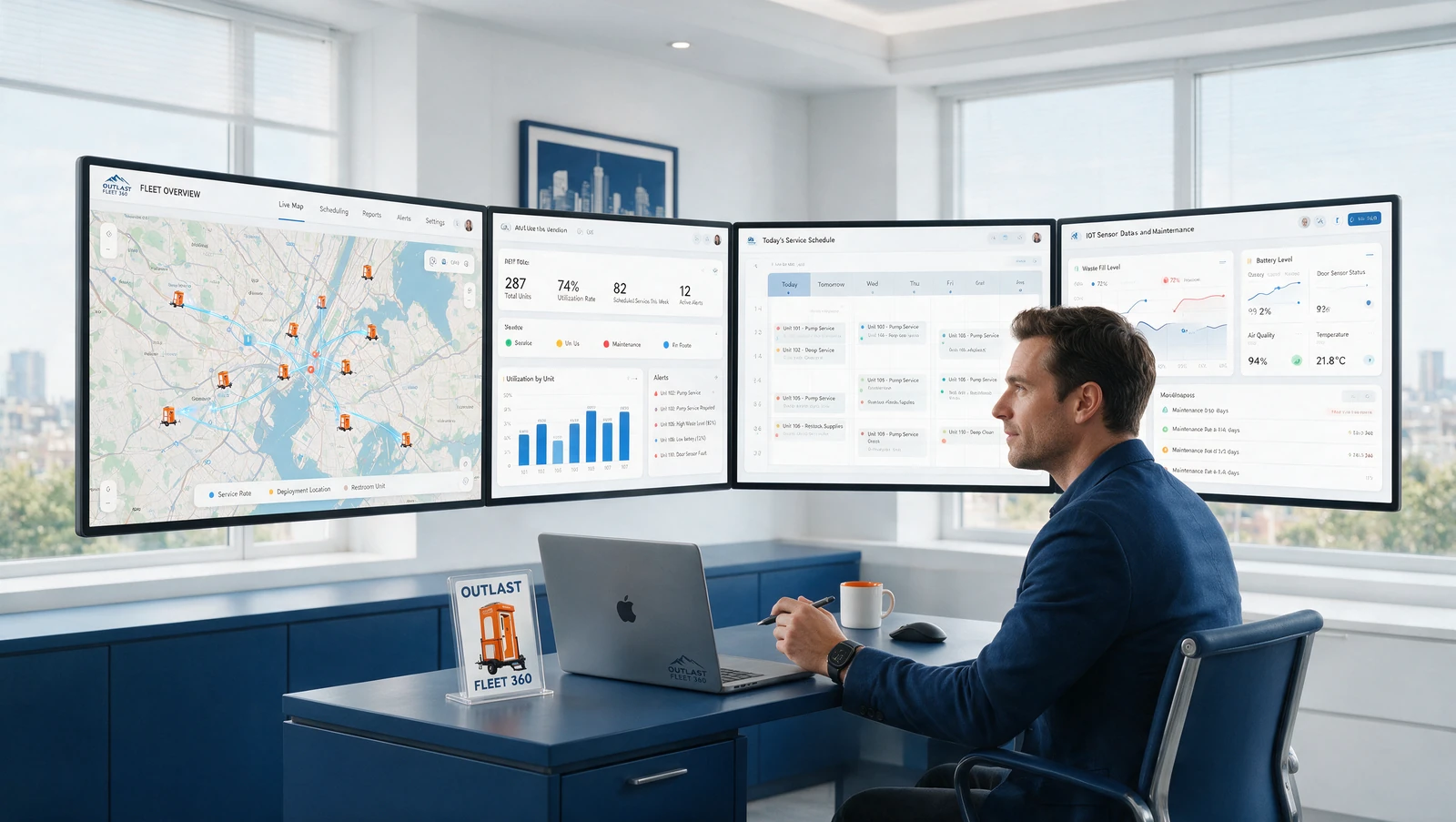
Cloud-based dashboards. Centralized software aggregates data from every unit into a single view, so an operator can see the entire fleet’s status, location, and performance from one screen.
Mobile applications for field technicians. Service teams receive assignments, routes, and unit details on their phones, and update service records in real time from the field.
Automated booking systems. Rental requests, availability checks, and scheduling are coordinated in one place, eliminating the double bookings and missed deliveries that plague manual processes.
Individually, each of these tools solves a specific problem. Integrated together, they form the modern category of software purpose-built for this industry: the smart restroom management platform. The connective tissue that links sensors, dashboards, and workflows into a single system is what we examine in our pillar guide, What Is a Smart Restroom Management Platform?
Does Your Business Need Fleet Management?
Not every operator needs a fleet management platform on day one. A business with five units serving a single town can run effectively on disciplined manual processes. The question is when that stops being true.
The transition point typically arrives when one or more of the following becomes true:
- The fleet exceeds 20 units, making manual tracking unreliable.
- Operations span multiple cities or states, multiplying logistics and compliance complexity.
- The business is losing measurable revenue to scheduling errors, idle units, or missing equipment.
- Customers increasingly expect real-time confirmation and reliable service that manual coordination cannot guarantee.
Below that threshold, structured processes with basic tools may be enough. Above it, the cost of not having fleet management in lost units, idle capital, reactive repairs, and missed bookings quickly exceeds the cost of the system that would prevent them.
Fleet management is ultimately not about technology for its own sake. It is about turning a collection of scattered, hard-to-track assets into a coordinated, measurable, and profitable operation.
Conclusion
Portable restroom fleet management is the structured discipline of tracking, maintaining, deploying, and optimizing every unit a business owns. Its four pillars visibility, utilization, maintenance, and compliance address the exact problems that cause manual operations to break down as a business grows.
The industry did not invent these principles. It inherited them from trucking, construction, and waste management, where fleet management long ago became the standard for running mobile assets profitably. What is new is that the technology to apply them GPS, IoT sensors, cloud dashboards, and integrated platforms is now affordable and purpose-built for portable sanitation.
For operators feeling the strain of growth, fleet management is not a luxury or an abstraction. It is the framework that makes the difference between a business that scales and one that stalls. The next step is understanding the technology that powers it beginning with the sensors that give a portable restroom the ability to report its own status in real time.
Frequently Asked Questions
What is portable restroom fleet management?
Portable restroom fleet management is the practice of tracking, maintaining, deploying, and optimizing all portable restroom units across locations using technology. It rests on four pillars fleet visibility, utilization optimization, maintenance management, and compliance documentation and aims to maximize the revenue each unit generates while minimizing the cost of operating it.
What metrics should I track for my portable restroom fleet?
At minimum, track fleet utilization rate, revenue per unit per month, average maintenance turnaround time, equipment loss and damage rate, customer satisfaction by location, and maintenance cost per unit. Each metric maps to a specific decision about expanding, deploying, purchasing, or retiring units.
How is portable restroom fleet management different from vehicle fleet management?
Portable restrooms are stationary but widely distributed assets, serviced based on usage rather than mileage, and often deployed in remote locations without connectivity. Trailer-mounted units are also regulated as vehicles under DOT and require VIN registration. These differences mean generic vehicle fleet tools rarely fit the industry well, which is why purpose-built platforms have emerged.
Do small operators need fleet management software?
Operators with 20 or more units across multiple locations benefit most from dedicated fleet management software. Below that threshold, structured manual processes with basic tools may be sufficient. The transition becomes urgent when a business begins losing revenue to scheduling errors, idle units, or untracked equipment.
What is a good fleet utilization rate for portable restrooms?
Utilization rate equals time rented divided by total available time. There is no universal target, but consistently low utilization signals that a business owns more units than its market demands, while utilization near 100% signals unmet demand and an opportunity to expand. The value of the metric is in tracking the trend and acting on it, rather than hitting a fixed number.


Leave a Reply
You must be logged in to post a comment.