Table of Contents

Introduction Maintenance Costs Kill Profitability
In a portable restroom business, maintenance is not a side function it is the single largest controllable cost. And for most operators, that cost is far higher than it needs to be.
The reason is simple: the majority of portable restroom operators still run reactive maintenance. A customer calls to report a broken flush. A technician drives out, discovers the part is not on the truck, drives back to the warehouse, picks up the part, drives out again, and completes the repair. Two trips, four hours, one unhappy customer for a problem that a sensor alert could have flagged three days earlier.
Industry benchmarks consistently show that reactive maintenance costs 2–3x more than preventive maintenance. Emergency dispatches require premium labor scheduling. Express parts orders carry surcharges. Extended downtime means lost rental revenue. And the customer experience a broken unit that stays broken until someone complains loudly enough erodes the trust that generates repeat bookings and referrals.
This is the second of the five core problems we identified in Why Traditional Portable Restroom Operations Are Inefficient: maintenance that is always reactive, never proactive, and impossibly expensive as a result.
Portable restroom maintenance software solves this by automating three things that manual operations cannot do consistently: scheduling service based on actual conditions, routing technicians efficiently, and tracking every job from request to completion.
Three Levels of Maintenance Maturity
Not all maintenance is created equal. The portable sanitation industry is moving through three levels of maintenance maturity, and where an operator sits on this spectrum directly determines their cost structure, customer satisfaction, and competitive position.
Level 1: Reactive Maintenance Fix When Broken
This is the default for most operators today. No scheduled inspections. No sensor data. No system at all just a phone that rings when something fails. The technician shows up after the problem has already affected the customer. Costs are highest because every job is an emergency. Customer satisfaction is lowest because the failure always comes first.
Level 2: Preventive Maintenance Service on a Fixed Schedule
A meaningful improvement. Operators set calendar-based service intervals every unit gets inspected every two weeks, every waste tank gets pumped on a fixed schedule. This catches many problems before they become customer-facing failures. But it also wastes resources: units that do not need service get serviced, while units that need service before their scheduled date go unattended.
Level 3: Predictive Maintenance Sensor Data Triggers Service
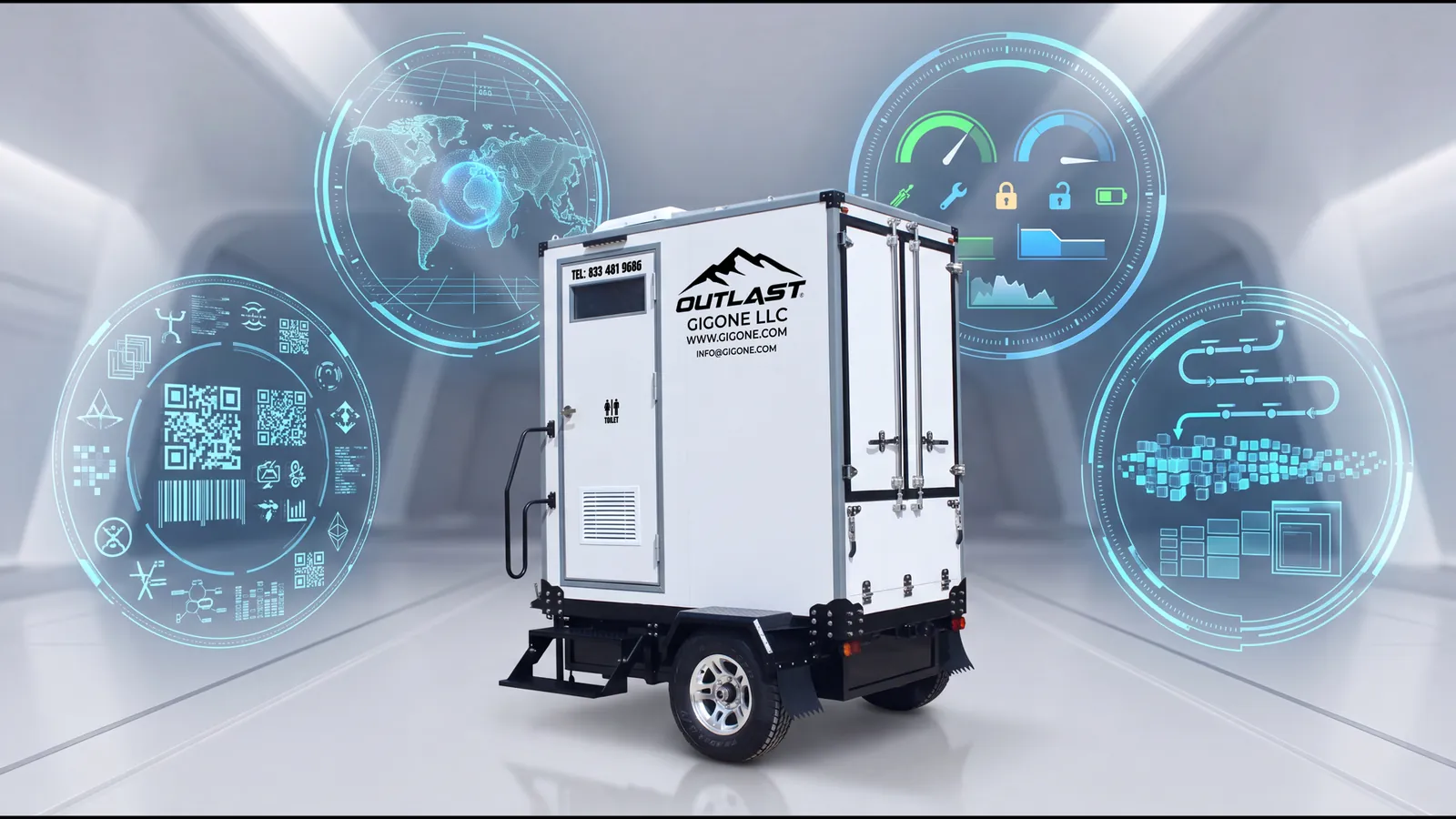
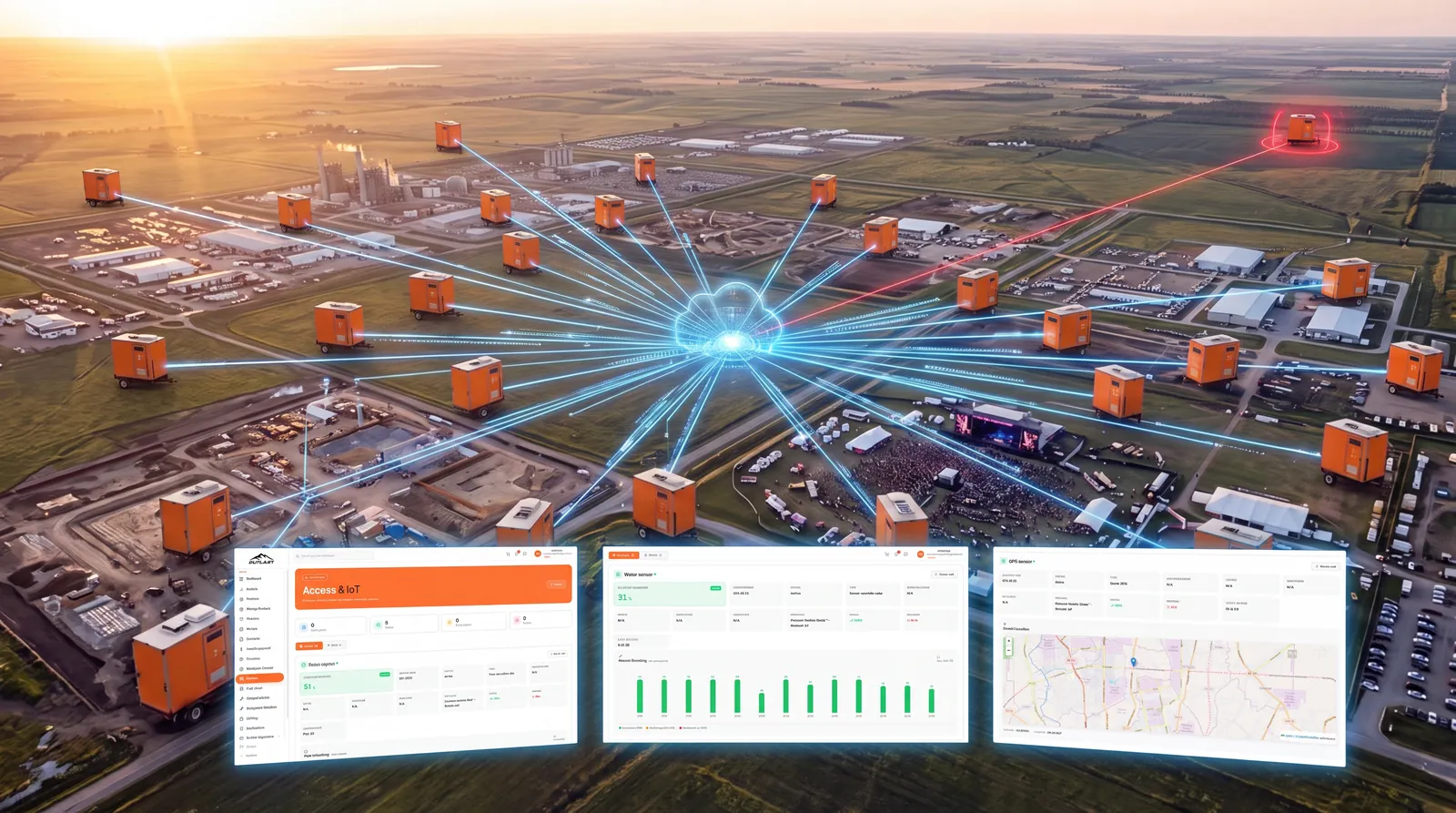
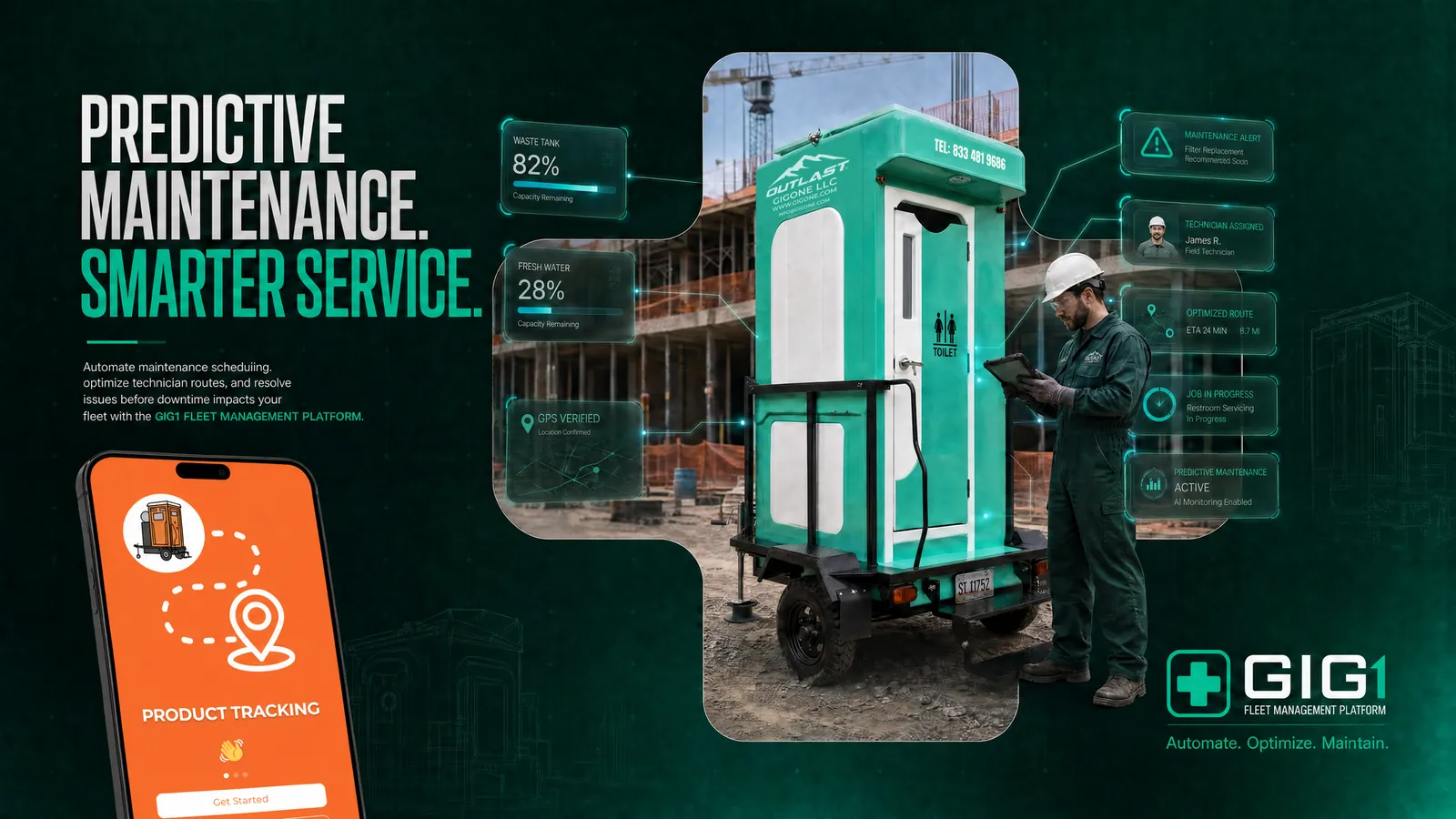
The optimal approach, and the level that GIG1 FLEET MANAGEMENT PLATFORM enables. IoT sensors continuously monitor water levels, waste tank capacity, and GPS position. When a threshold is crossed water below 30%, waste above 80%, GPS anomaly detected the system generates an alert that flows directly into the maintenance workflow. Service happens when the unit actually needs it: not too early (wasting resources), not too late (causing failures).
| Approach | Trigger | Cost Profile | Customer Impact |
|---|---|---|---|
| Reactive | Customer complaint or breakdown | Highest emergency dispatch, premium parts | Worst failure occurs before response |
| Preventive | Fixed calendar schedule | Moderate regular visits, some waste | Better fewer failures, occasional gaps |
| Predictive | Real-time sensor thresholds | Lowest service only when needed | Best problems solved before noticed |
The shift from Level 1 to Level 3 is not just an efficiency gain it is a business model transformation. Operators who achieve predictive maintenance spend less money while delivering better service, a combination that compounds into higher margins and stronger customer retention.

Why Portable Restroom Maintenance Is Uniquely Difficult
Maintaining portable restrooms is harder than maintaining most fleet assets, and the reasons go beyond logistics.
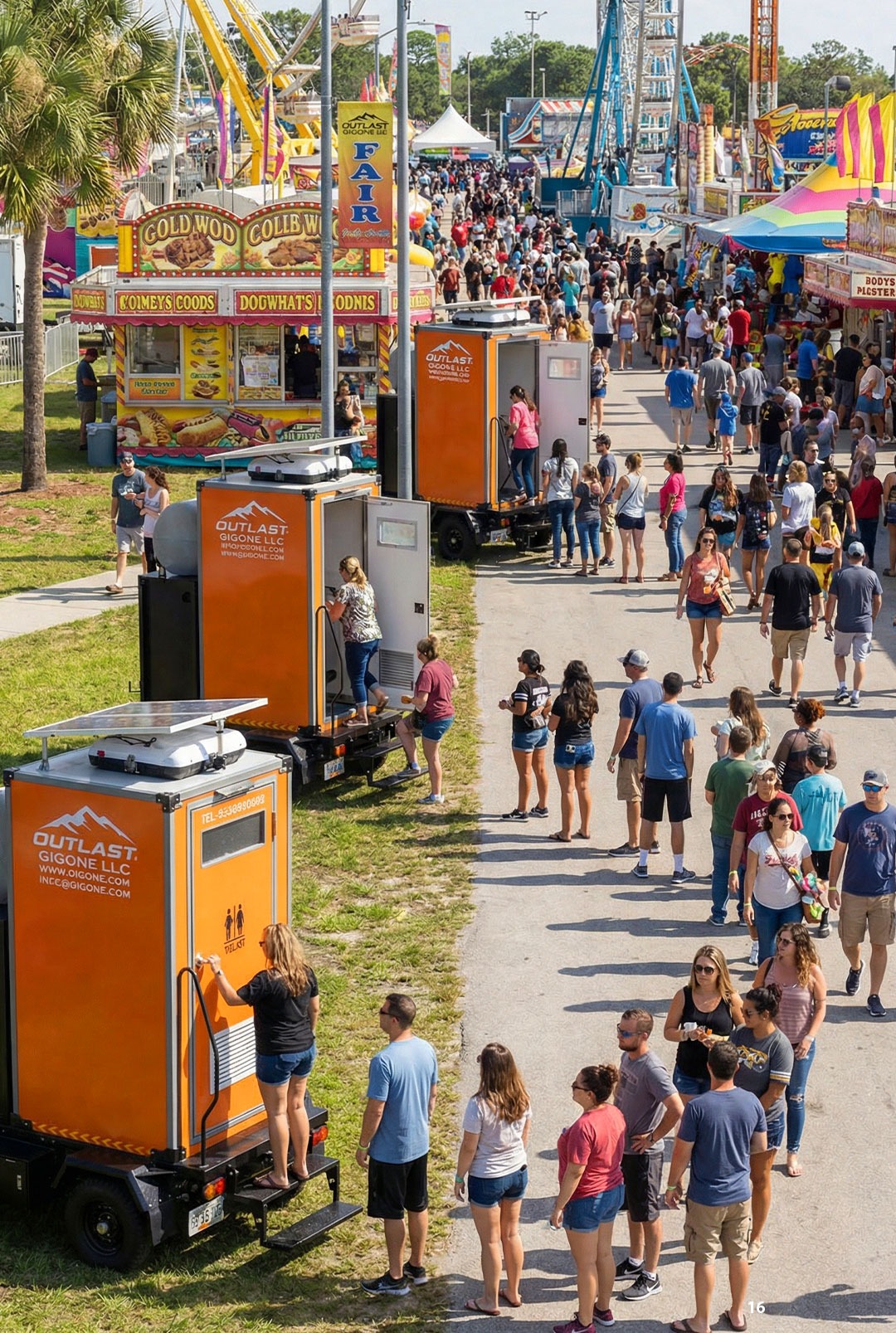
Units are dispersed. A portable restroom fleet is not parked in one depot. Units are scattered across construction sites, event venues, parks, and private properties sometimes spanning multiple cities and states. Every maintenance job starts with travel, and travel is the largest cost component in field service operations.
No fixed infrastructure. Unlike building-based restrooms with permanent plumbing, portable restrooms operate autonomously. Fresh water depletes. Waste tanks fill. Components wear. And because there is no permanent connection to any monitoring system, the unit’s condition between service visits is unknown unless IoT sensors are deployed.
Model-specific requirements. Not every portable restroom is maintained the same way. A Premium Mobile Oasis™ – Model AA-1P with its anti-freezing system, vacuum toilet, AC unit, and 200W solar panel requires a different maintenance protocol than a C-1P Professional Flush Portable Restroom with its standard toilet and emergency discharge valve. Generic maintenance schedules that treat every unit identically either over-service simple units or under-service complex ones.
Seasonal variability. Demand peaks summer festivals, construction season, holiday events create surges that stress maintenance capacity. Winter deployments in northern states require anti-freeze system inspections on Premium models. Operators without a system to anticipate these peaks find themselves overwhelmed during the busiest periods, precisely when downtime is most costly.
These challenges make portable restroom maintenance software not a luxury but a competitive requirement for operators managing fleets beyond a handful of units.
The GIG1 FLEET MANAGEMENT PLATFORM Maintenance Request Workflow From Alert to Resolution
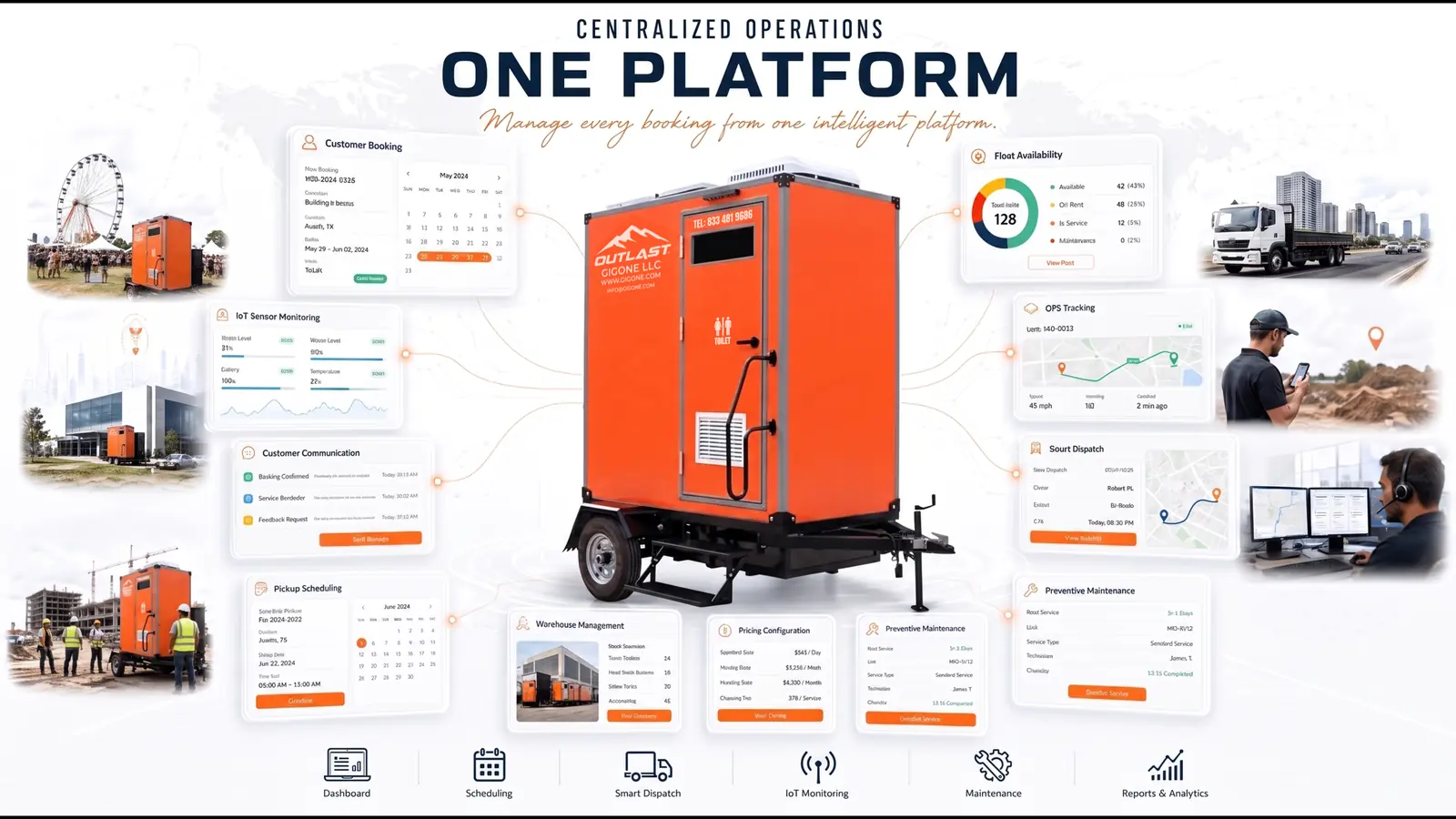
GIG1 FLEET MANAGEMENT PLATFORM’s maintenance module follows a structured six-step workflow that takes a maintenance need whether triggered by a sensor alert, a customer request, or a scheduled inspection and converts it into a dispatched, trackable job.
Step 1: Maintenance request arrives.
Requests enter the system through two channels:
- Sensor-triggered alerts: IoT sensors detect a threshold water level below 30%, waste level above 80%, GPS anomaly, or sensor offline and the system generates an automatic alert on the partner dashboard.
- Customer-submitted requests: Customers log into the platform, navigate to their rented product, and submit a request specifying the service type (e.g., Repair), priority level (High, Medium, or Low), and a description of the issue.
Step 2: Partner opens Route Planner.
The partner clicks on the maintenance request and opens the Route Planner interface. The system displays the unit’s current GPS location on an interactive map not the address from the original booking, but the unit’s actual real-time position from its GPS sensor.
Step 3: Assign technician.
The partner selects a technician based on availability and proximity. The Route Planner shows each technician’s current assignment status and location relative to the unit requiring service.
Step 4: Calculate optimal route.
The system calculates the route from the selected starting warehouse to the unit’s GPS position. The calculation includes distance, estimated travel time, and the number of stops enabling multi-stop routes when multiple units in the same area need service.
Step 5: Create Maintenance Plan.
The partner confirms the route, the assigned technician, and the service scope, then clicks Create Maintenance Plan to dispatch the job. The system records the plan and moves the job to active status.
Step 6: Customer notification.
The system automatically sends a “Maintenance Job Notification” email to the customer, including the job code, assigned technician, and estimated service schedule. The customer can track progress through the platform without calling the operator.
This six-step workflow replaces what most operators do today receive a phone call, check a spreadsheet for the unit’s supposed location, call a technician, give verbal directions, and hope the job gets done. In the GIG1 FLEET MANAGEMENT PLATFORM system, every step is recorded, every route is optimized, and every customer is informed.
Route Planning & Technician Assignment
Route planning is where maintenance software delivers its most immediate ROI. In a manual operation, a technician receives a list of addresses and drives between them in whatever order seems logical. In a system-optimized operation, the route is calculated based on actual GPS positions, distances, travel times, and service priorities.
Starting point selection. The partner selects the warehouse from which the technician will depart. Because GIG1 FLEET MANAGEMENT PLATFORM supports multiple warehouse types Service, Storage, and Distribution the system can route from the warehouse closest to the service cluster, not necessarily the partner’s primary facility.
Multi-stop routing. When several units in the same geographic area need service a common scenario when sensor alerts trigger across a cluster of units deployed at nearby sites the route planner builds an efficient multi-stop itinerary. The system calculates total distance, total travel time, and number of stops for the complete route.
Distance and time calculation. The route planner measures the actual distance from the starting warehouse to each unit’s GPS coordinates. This eliminates the common problem of routing to an address that is no longer accurate because the unit was moved during the rental period.
Technician matching. Partners assign technicians based on two criteria: availability (not currently on another job) and proximity (closest to the service area). For model-specific maintenance such as anti-freeze system servicing on Premium models or emergency discharge valve testing on the C-1P Professional partners can also match technicians by certification or experience with that model type.
The cumulative effect is significant. Operators who adopt route-optimized maintenance scheduling typically see reductions in fuel costs, labor hours per job, and average response time three metrics that directly impact both profitability and customer satisfaction.
Model-Specific Maintenance Requirements
One of the most overlooked aspects of portable restroom maintenance is that different models require different service protocols. A fleet with multiple product segments cannot be maintained on a single generic schedule.
GIG1 FLEET MANAGEMENT PLATFORM addresses this by tying maintenance requirements to the asset’s product model, stored in its asset profile through the asset tracking system.
Premium Mobile Oasis™ – Model AA-1P and Premium Mobile Oasis™ – Model A-1P:
These Premium tier models share the most complex maintenance profile in the Gigone lineup:
- Anti-freezing system inspection. Both models feature active anti-freeze systems with integrated heating elements that ensure stable water flow in extreme cold without chemicals. Before winter deployments, technicians must verify heating element functionality, thermostat calibration, and insulation integrity.
- Vacuum toilet servicing. The foot-pedal vacuum flush system requires periodic inspection of the vacuum seal, pedal mechanism, and water-saving calibration.
- AC and hot water system maintenance. Both models include air conditioning and water heating mechanical systems that require seasonal checks, filter cleaning, and component testing.
- Solar panel inspection. The integrated 200W solar system needs periodic cleaning and output verification to maintain battery charging capacity.
- 3-valve waste separation system. The solid-liquid separation system with three independent discharge valves filtered water, settled sludge, and full solid waste requires inspection of valve seals and discharge line integrity.
Flare Mobile Oasis A-1P:
- Vacuum toilet servicing same protocol as Premium models
- Strong ventilation system maintenance the Flare’s enhanced odor extraction system requires fan motor and duct inspection
- Bold orange exterior cosmetic maintenance for the distinctive design element that defines this model’s visual identity at events
Pearl Mobile Oasis B-1P:
- Nano material surface care the Pearl’s luxury nano-coated surfaces and polished aluminum floors require specific cleaning agents and techniques to maintain their finish
- Standard toilet maintenance different servicing protocol than vacuum toilet models
- Automatic water shut-off float valve periodic calibration to prevent water waste
C-1P Professional Flush Portable Restroom:
- Emergency discharge valve testing. The C-1P’s unique emergency discharge system allows rapid waste release during overload or urgent maintenance situations this valve must be tested for reliable operation, especially before high-traffic construction or event deployments.
- Corrosion-resistant composite inspection. The C-1P uses composite materials rather than aluminum panels different inspection criteria for structural integrity.
- Manual lighting switch. Unlike the auto-sensor lighting in Premium and Luxury models, the C-1P uses manual interior switches a simpler system but one that can develop contact issues in harsh construction environments.
By storing these model-specific requirements in the asset profile and surfacing them during maintenance planning, GIG1 FLEET MANAGEMENT PLATFORM ensures that technicians arrive with the right parts, tools, and knowledge for the specific unit they are servicing.
Service History & Predictive Insights
Every maintenance event recorded in GIG1 FLEET MANAGEMENT PLATFORM contributes to a growing dataset that enables increasingly precise maintenance predictions.
Per-unit service history accumulates over time:
- Last Maintenance date when the unit was last serviced
- Next Maintenance date when the next service is due, based on schedule or sensor data
- Total Rental Days and Total Rental Hours usage intensity that predicts wear rates
- Service type records distinguishing between routine pump-outs, part replacements, sensor recalibrations, and emergency repairs
IoT sensor data adds the real-time dimension. While service history tells you what happened, sensor data tells you what is happening now and what is about to happen:
- Water level trending downward faster than historical average → high-usage deployment, schedule earlier refill
- Waste level reaching 80% threshold with three days remaining until scheduled pump-out → dispatch service now, do not wait for the scheduled date
- Sensor signal strength declining → schedule connectivity check before the sensor goes fully offline
- GPS position unchanged for an unusually long period on a unit marked “In Transit” → investigate potential breakdown or data error
These two data streams historical service records and real-time sensor readings converge to enable the predictive maintenance model that transforms operator economics. For the technical details on how each sensor type works and generates alerts, see IoT Restroom Monitoring: How Smart Sensors Track Water, Waste & Location.
Maintenance Job Tracking Visibility at Every Stage
Once a maintenance plan is created and dispatched, the job enters a tracking pipeline visible to both the partner and the customer.
Job status progression:
- PENDING Job created, technician assigned, not yet started
- IN PROGRESS Technician en route or actively servicing the unit
- COMPLETED Service finished, unit returned to operational status
Partners view all active and completed jobs on the Maintenance Jobs page, with filters for status, assigned staff, product model, and date range. The Monthly Maintenance Overview chart visualizes service volume trends helping partners anticipate staffing needs before peak periods.
Maintenance Count by Product tracked in the analytics dashboard reveals which models require the most service attention. A product showing disproportionately high maintenance frequency relative to its rental hours signals a potential replacement or upgrade decision. This data feeds directly into the strategic analytics that drive fleet composition decisions, as covered in Restroom Rental Business Analytics.
Customer visibility closes the communication loop. Instead of calling the operator to ask “when is the technician coming?” or “was my unit fixed?”, customers track their maintenance request status through the platform and receive email notifications at each stage change. This reduces inbound support calls while improving the customer experience a rare efficiency-satisfaction double win.
Best Practices for Reducing Fleet Downtime
Based on the capabilities that maintenance software enables, operators can adopt several practices that significantly reduce fleet downtime and maintenance costs:
Set preventive schedules based on rental hours, not calendar dates. A unit rented for 12 hours a day at a busy construction site needs service far sooner than a unit deployed at a low-traffic location with occasional weekend use. Rental hour thresholds, tracked in the asset profile, provide a more accurate trigger than fixed intervals.
Use sensor alerts as the primary maintenance trigger. When IoT sensors are deployed, sensor data should override calendar schedules. A waste level alert at 80% capacity demands action regardless of whether the scheduled pump-out is tomorrow or next week.
Prepare for seasonal demands proactively. Before winter deployments in cold-weather states, schedule anti-freeze system inspections for all Premium Mobile Oasis™ models. Before summer event season, verify vacuum toilet functionality and ventilation systems across the fleet. Historical analytics reveal seasonal patterns that make these preparations predictable.
Build multi-stop routes for geographic clusters. When multiple units in the same city or region generate maintenance needs, batch them into a single multi-stop route rather than dispatching individual trips. The fuel, labor, and time savings compound with fleet size.
Track maintenance cost per unit against revenue per unit. The analytics dashboard enables repair-versus-replace analysis at the individual unit level. When a unit’s cumulative maintenance cost approaches a threshold relative to its revenue contribution, the data supports a replacement decision removing emotion and habit from what should be an economic calculation.
Maintain EPA-compliant waste handling records. Every pump-out, waste discharge, and disposal event should be documented in the maintenance record. Digital records in GIG1 FLEET MANAGEMENT PLATFORM replace paper logs, providing audit-ready compliance documentation that meets EPA guidelines for portable sanitation waste handling.
Conclusion
Portable restroom maintenance is the single largest controllable cost in a rental operation and the single largest opportunity for improvement. The gap between reactive maintenance (fix when broken) and predictive maintenance (fix before it matters) is not a marginal efficiency gain. It is a 2–3x cost difference that compounds across every unit, every month, every year.
Portable restroom maintenance software closes that gap by automating what manual operations cannot do consistently: trigger service based on real-time sensor data, route technicians efficiently to actual GPS positions, track every job from request to completion, and accumulate service histories that make each subsequent maintenance decision smarter.
In the GIG1 FLEET MANAGEMENT PLATFORM ecosystem, maintenance is not a standalone function. It connects to asset tracking (every unit’s service history lives on its asset profile), to IoT monitoring (sensor alerts trigger maintenance workflows), to booking (units under maintenance are automatically unavailable for rental), and to analytics (maintenance KPIs inform fleet composition decisions).
For a broader view of how maintenance fits into the complete smart restroom operations platform, see What Is a Smart Restroom Management Platform?.
Frequently Asked Questions
How much does reactive maintenance cost compared to preventive?
Industry data consistently shows reactive maintenance costs 2–3x more than preventive approaches. The premium comes from emergency dispatch labor, express parts procurement, extended equipment downtime (lost rental revenue), and the customer satisfaction damage that follows every service failure.
How does sensor data trigger maintenance in GIG1 FLEET MANAGEMENT PLATFORM?
When IoT sensors detect critical thresholds water level below 30%, waste level above 80%, GPS anomaly, or sensor offline the system generates an alert on the partner dashboard. The partner can convert this alert into a dispatched work order through the Route Planner in minutes, with the technician routed to the unit’s actual GPS position.
What maintenance is specific to Premium models?
Premium Mobile Oasis™ – Model AA-1P and Model A-1P require anti-freeze system inspection before winter deployments, vacuum toilet servicing, AC and hot water system checks, solar panel cleaning and output verification, and 3-valve waste separation system inspection. These requirements are tied to the asset’s model profile in GIG1 FLEET MANAGEMENT PLATFORM.
How does the C-1P Professional differ in maintenance?
The C-1P Professional Flush Portable Restroom features an emergency discharge valve for rapid waste release during high-traffic deployments. This valve requires periodic testing for reliable operation. The C-1P also uses composite materials instead of aluminum panels, requiring different structural inspection criteria, and has manual interior lighting switches instead of automatic sensors.
Can maintenance software reduce the number of service trips?
Yes. Predictive maintenance triggered by IoT sensors reduces unnecessary trips (servicing units that do not need it yet) and emergency trips (responding to failures that could have been prevented). Combined with multi-stop route optimization, operators typically achieve significant reductions in total service trips while improving service reliability.