Table of Contents
Introduction The Industry Problem: Equipment Disappears
Of all the problems in traditional portable restroom operations, equipment loss is the most quietly expensive. A unit does not vanish in a dramatic event it drifts. It gets moved from one job site to another without documentation. It gets left at a completed event because no one updated the spreadsheet. It gets loaded onto the wrong truck during a busy morning and ends up three cities away with no record of the transfer.
The cost compounds. A single misplaced premium unit like the Premium Mobile Oasis™ – Model AA-1P with its trailer, solar system, and vacuum toilet represents thousands of dollars in idle capital. Multiply that by a fleet of 50 or 100 units across multiple cities, and the annual cost of poor asset tracking can exceed the price of several new units.
This is the first of the five core problems we identified in Why Traditional Portable Restroom Operations Are Inefficient: operators running fleets without a digital asset registry, without GPS tracking, and without a system that ties identity, location, status, and history into one searchable record.
Portable restroom asset tracking solves this. Not with a single feature, but with a layered system that gives operators complete visibility into every unit they own where it is, what condition it is in, when it was last serviced, and whether it is generating revenue or sitting idle.
What Asset Tracking Means for Portable Sanitation
Asset tracking in portable sanitation goes beyond “knowing where your units are.” That is only one layer. A complete asset tracking system manages the full lifecycle of every physical unit from the day it enters the fleet to the day it is retired.
Consider what an operator needs to know about a single portable restroom at any given moment:
- Identity: Which exact unit is this? What is its unique identifier, its VIN for DOT compliance, its serial number for inventory?
- Location: Where is it right now? Is it at a job site, in a warehouse, or in transit?
- Status: Is it available for rental? Currently deployed? Under maintenance? What condition is it in brand new, good, fair, or needing repair?
- History: How many days has it been rented? How many hours of use? When was it last serviced? When is the next maintenance due? What is its total revenue contribution?
Without a system that answers all four questions simultaneously, operators are forced to piece together partial information from multiple sources a GPS tracker here, a spreadsheet there, a technician’s memory for the rest.
The industries closest to portable sanitation solved this years ago. Trucking companies track every vehicle by VIN, GPS, and maintenance history in unified fleet platforms. Construction firms assign every piece of heavy equipment a digital identity that follows it from purchase to disposal. Waste management operators tag every container with sensors and track utilization across service zones.
Portable sanitation is catching up and asset tracking is the foundation that every other operational improvement depends on. You cannot optimize maintenance without knowing which unit needs service. You cannot prevent double bookings without knowing which units are available. You cannot analyze fleet performance without historical data per unit.
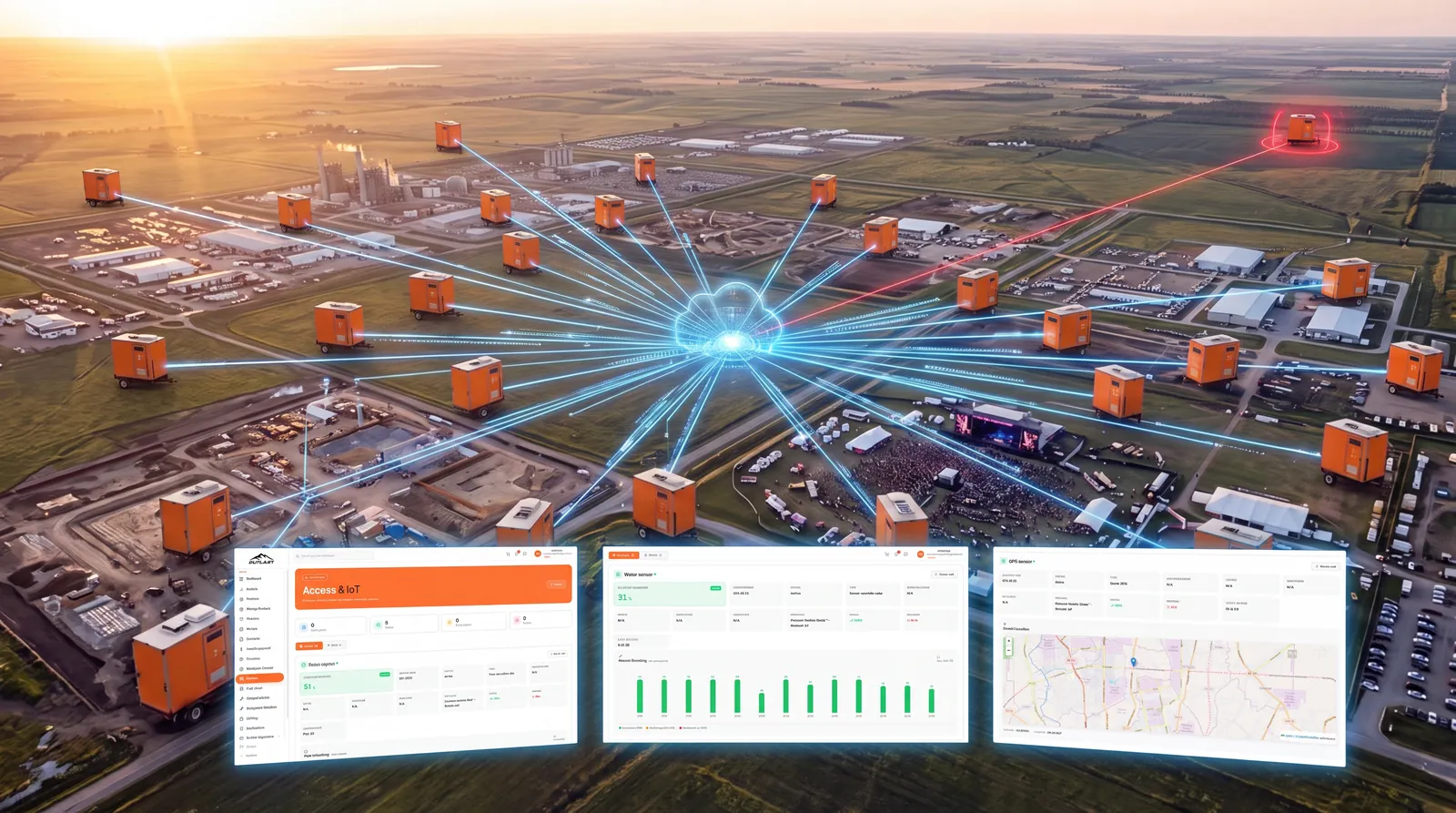
The 4 Layers of Asset Tracking
Effective asset tracking operates on four layers, each building on the one below it:
Layer 1: Identity Who is this unit?
Every unit needs a unique, permanent identifier that follows it through every transaction, transfer, and service event. In the GIG1 FLEET MANAGEMENT PLATFORM system, this identity has three components:
- Asset ID: A system-generated unique code in the format
#AST-YYYYMMDD-XXXXXXsortable by registration date, searchable across the entire fleet - VIN (Vehicle Identification Number): Required by DOT for trailer-mounted units, verifiable through the NHTSA VIN Decoder at vpic.nhtsa.dot.gov/decoder
- Serial Number / SKU: The manufacturer’s barcode identifier (e.g.,
1G9BR...) for inventory and warranty tracking
These three identifiers create a triangle of verification. If any record is questioned during an audit, an insurance claim, or a transfer dispute the Asset ID, VIN, and serial number cross-reference each other.
Layer 2: Location Where is this unit right now?
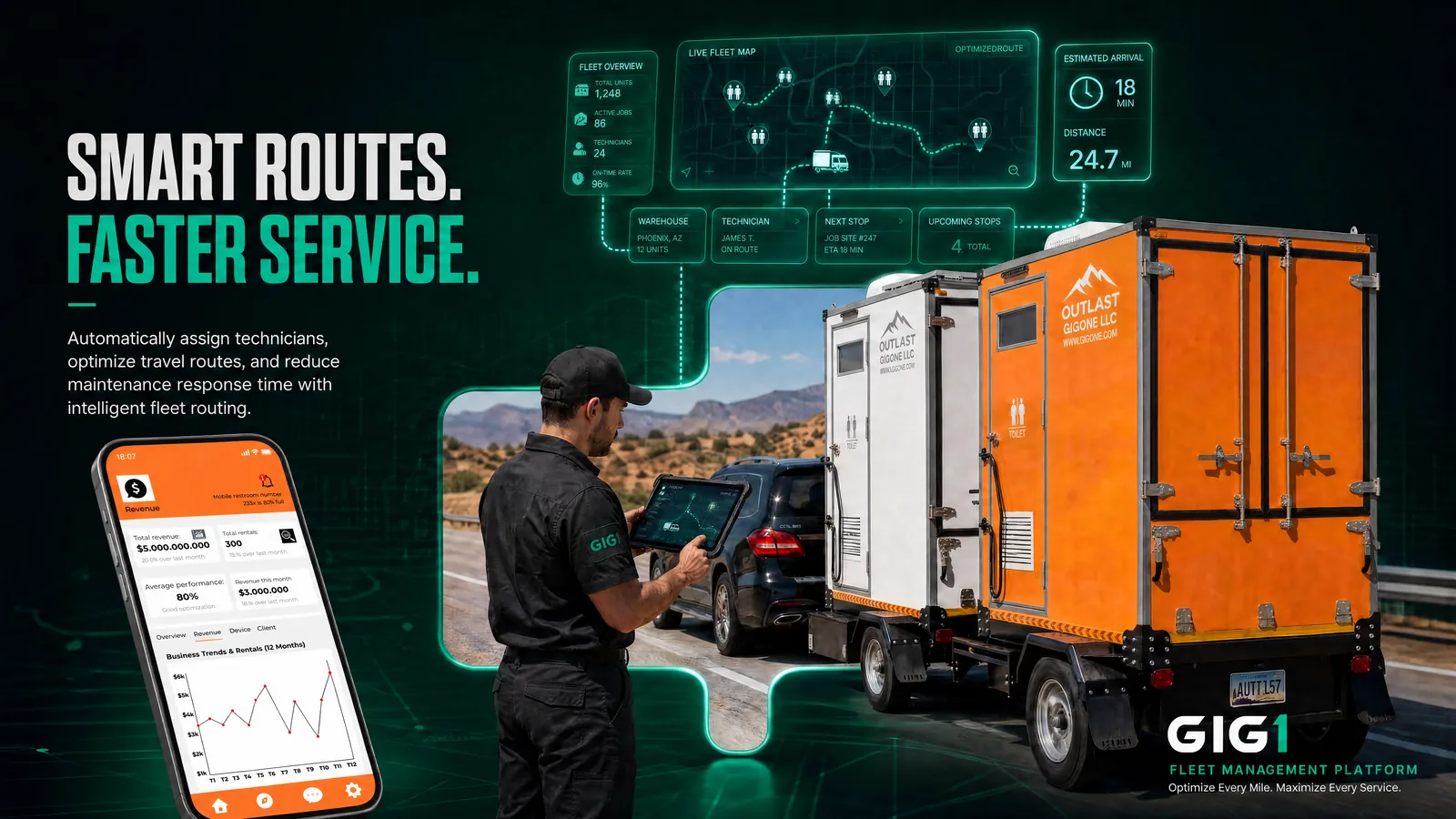
GPS sensors embedded in each unit transmit real-time coordinates to the GIG1 FLEET MANAGEMENT PLATFORM dashboard. On the Global Map view, partners see every asset as a pin on an interactive map with the ability to click any pin and see that unit’s full profile.
Location tracking solves three problems simultaneously:
- Theft detection: If a unit moves outside an expected area, the system flags it for investigation
- Retrieval efficiency: When a rental period ends, GPS pinpoints exactly where every unit sits no hunting, no guessing
- Route planning: Maintenance technicians route to the unit’s actual position, not to the address on file from three weeks ago
Layer 3: Status What condition is this unit in?
Each asset carries two parallel status indicators:
| Status Type | Options | What It Tells You |
|---|---|---|
| Availability | Available, In Use, Maintenance, In Transit | Can this unit be rented right now? |
| Condition | Brand New, Good, Fair, Needs Repair | Should this unit be rented right now? |
A unit can be “Available” in terms of scheduling but “Needs Repair” in condition meaning it should go to maintenance, not to a customer. Without both status dimensions, operators either send damaged units to job sites (hurting customer satisfaction) or leave repaired units sitting in the warehouse because no one updated their availability (losing revenue).
Layer 4: History What has this unit done?
The most valuable layer for long-term fleet management. Every unit accumulates a history record:
- Total Rental Days and Total Rental Hours measuring actual utilization
- Last Maintenance date and Next Maintenance date driving preventive scheduling
- Purchase Date and Warranty Status informing repair-versus-replace decisions
- Service Records every maintenance event, part replacement, and technician visit
This history transforms individual units from interchangeable boxes into data-rich assets. An operator looking at two seemingly identical units can see that Unit A has been rented 1,200 hours with zero unscheduled repairs, while Unit B has been rented 800 hours with three emergency service calls. That data drives decisions: deploy Unit A to the high-profile event; route Unit B to maintenance for inspection.
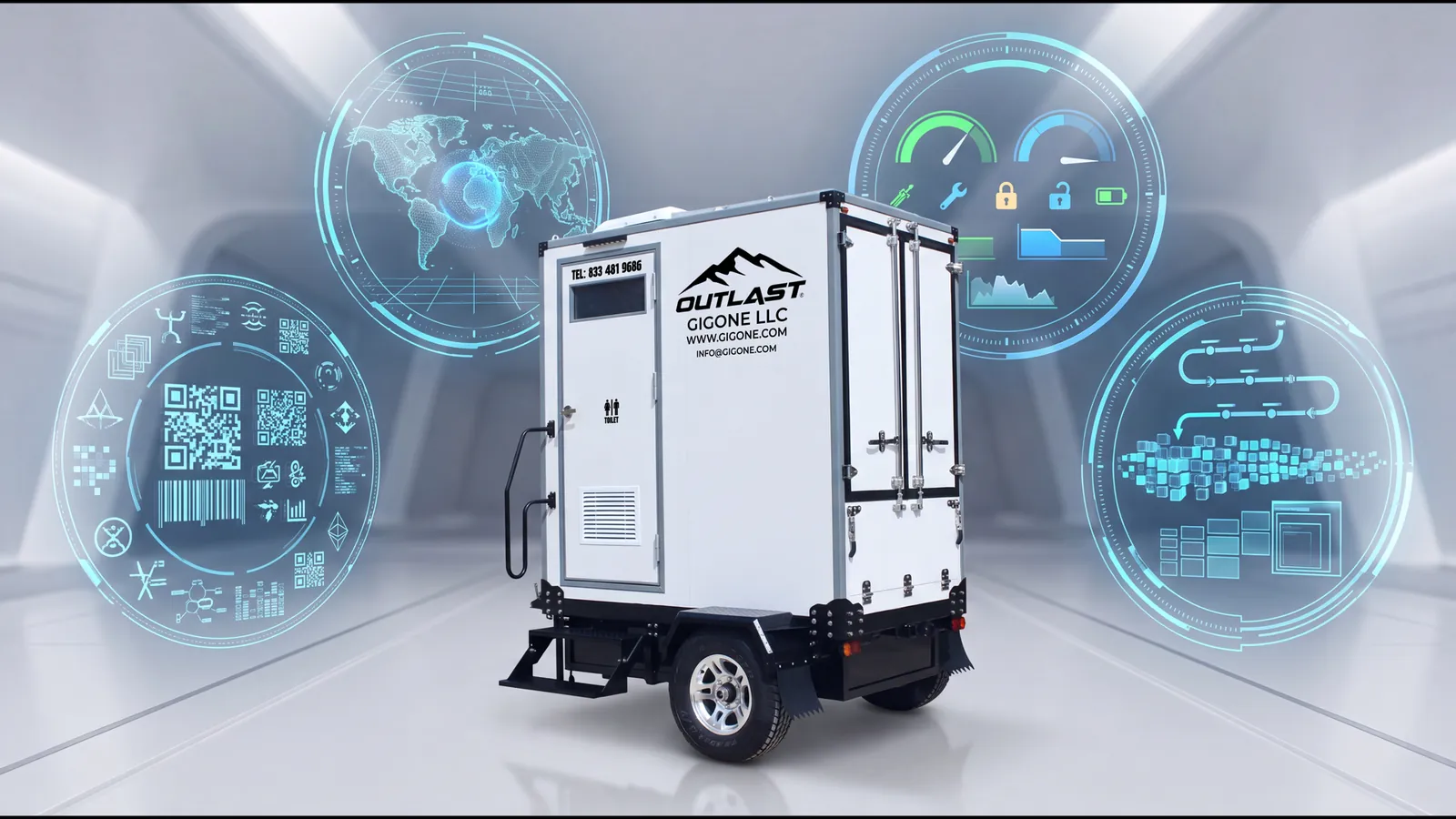
How GIG1 FLEET MANAGEMENT PLATFORM Implements Asset Tracking
The GIG1 FLEET MANAGEMENT PLATFORM asset management interface is built around the four-layer model. Partners access it through the Manage Products & Inventory section of the dashboard.
Asset Overview Cards provide instant fleet visibility:
- Total Assets: Every unit registered in the system
- Available: Units ready for rental
- In Use: Units currently deployed to customers
- Maintenance: Units in the service pipeline
Adding new assets is a manual process with intentional checkpoints. Partners click Add Asset and register each unit with its Asset ID, VIN, serial number, product model, condition, and assigned warehouse. This deliberate registration ensures every unit entering the fleet has a complete digital identity from day one no orphan units with missing data.
The Global Map is the visual centerpiece. Every registered asset with an active GPS sensor appears on the map, showing its real-time position. Partners can zoom into a specific city, click a pin, and instantly see that unit’s identity, status, condition, sensor readings (water level, waste level), and operational history.
Detailed Asset Inspection clicking on any asset in the inventory list reveals the full four-layer profile: specifications, purchase details, maintenance statistics (last/next maintenance, total rental days, total rental hours), current warehouse assignment, attached notes, and real-time sensor data.
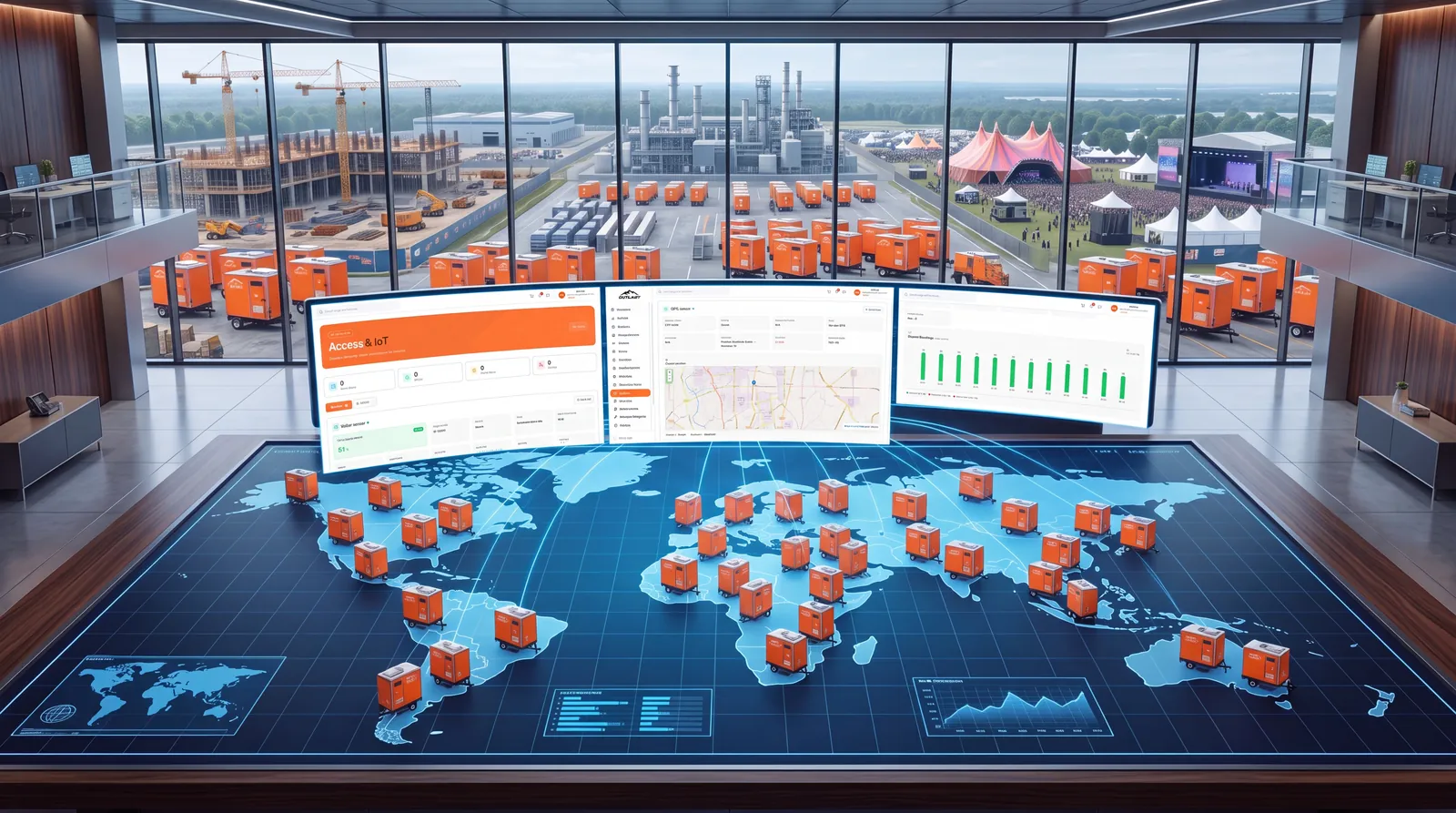
Warehouse & Inventory Management
Asset tracking extends beyond individual units to the facilities where units are stored. The GIG1 FLEET MANAGEMENT PLATFORM warehouse management system allows partners to organize their physical operations with the same precision as their fleet data.
Warehouse registration requires:
- Contact information: Phone number and email for inventory and order alerts
- Warehouse details: Name, type (Service, Storage, or Distribution), and maximum capacity
- Location: Address selected from an interactive map
- Operating hours: Open/closed status configured per day of the week
Warehouse types serve distinct operational functions:
- Service warehouses are where technicians perform maintenance and repairs
- Storage warehouses hold idle inventory waiting for deployment
- Distribution warehouses stage units for delivery to customer locations
Warehouse transfers track every movement between facilities. When a unit completes a rental and returns to a storage warehouse, or when it moves from storage to service for scheduled maintenance, the transfer is recorded maintaining an unbroken chain of custody.
Capacity management prevents overcrowding. Each warehouse has a defined maximum capacity, and the system shows current occupancy against that limit. Partners planning seasonal inventory staging moving extra units into high-demand cities before summer event season, for example can verify warehouse capacity before initiating transfers.
Products Tracked in GIG1 FLEET MANAGEMENT PLATFORM The Full Gigone Lineup
Every product in the GIG1 FLEET MANAGEMENT PLATFORM system belongs to one of five models, each serving a distinct market segment:
| Model | Segment | Water Tank | Waste Tank | Key Differentiator |
|---|---|---|---|---|
| Premium Mobile Oasis™ – Model AA-1P | Premium (Highest) | 300L | 500L | AC, hot water, Bluetooth, 200W solar, anti-freeze, 3-valve waste separation |
| Premium Mobile Oasis™ – Model A-1P | Premium | 300L | 500L | Rapid 3-min deployment, baby changing station, anti-freeze |
| Flare Mobile Oasis A-1P | Premium | 300L | 450L | Bold orange design, vacuum toilet, strong ventilation |
| Pearl Mobile Oasis B-1P | Luxury | 300L | 450L | Nano materials, polished aluminum, minimalist white design |
| C-1P Professional Flush Portable Restroom | Professional | 250L | 300L | Emergency discharge valve, construction-grade composite, corrosion-resistant |
Asset tracking at the model level enables segment-specific analysis. Partners can compare utilization rates across segments is the Premium tier generating more revenue per hour than the Professional tier? Are Luxury units sitting idle while Professional units are fully booked? and make purchasing decisions based on data rather than assumptions.
Each model’s specifications toilet type (vacuum vs. standard), power system (integrated solar vs. optional), wall construction (aluminum panel vs. composite) also inform maintenance protocols. The asset management system stores model-specific service requirements alongside individual unit history, so maintenance teams know whether a unit needs anti-freeze system inspection (Premium models) or emergency discharge valve testing (C-1P Professional).
DOT & VIN Compliance Why It Matters for Trailer-Mounted Units
Every Gigone portable restroom is trailer-mounted, which means every unit is legally a trailer under U.S. Department of Transportation regulations. This has specific compliance implications that asset tracking must address.
VIN (Vehicle Identification Number) is the DOT’s primary identification standard for trailers. Every Gigone unit carries a VIN that:
- Proves legal ownership critical for insurance claims, theft reports, and transfer of title
- Enables NHTSA database lookup any law enforcement officer or regulatory inspector can verify the unit’s identity through vpic.nhtsa.dot.gov/decoder
- Satisfies DMV registration requirements trailer-mounted restrooms require valid registration plates for legal road transport
Vehicle ID Plate & Registration Plate are physical compliance markers. Each Gigone unit is equipped with both the manufacturer’s VIN plate and a valid registration plate ensuring that units can be legally transported between job sites, warehouses, and service locations without risk of roadside violation.
Digital records vs. paper audit trails. Traditional operators maintain compliance documentation in filing cabinets paper VIN records, photocopied registration cards, handwritten service logs. This works until an auditor asks for a specific unit’s complete compliance history, and the operator spends hours searching through folders.
In GIG1 FLEET MANAGEMENT PLATFORM, every unit’s VIN, registration status, DOT certification, and compliance history is stored in its digital asset profile searchable, exportable, and accessible in seconds. This is not a convenience feature it is audit readiness.
From Tracking to Action How Asset Data Feeds Other Systems
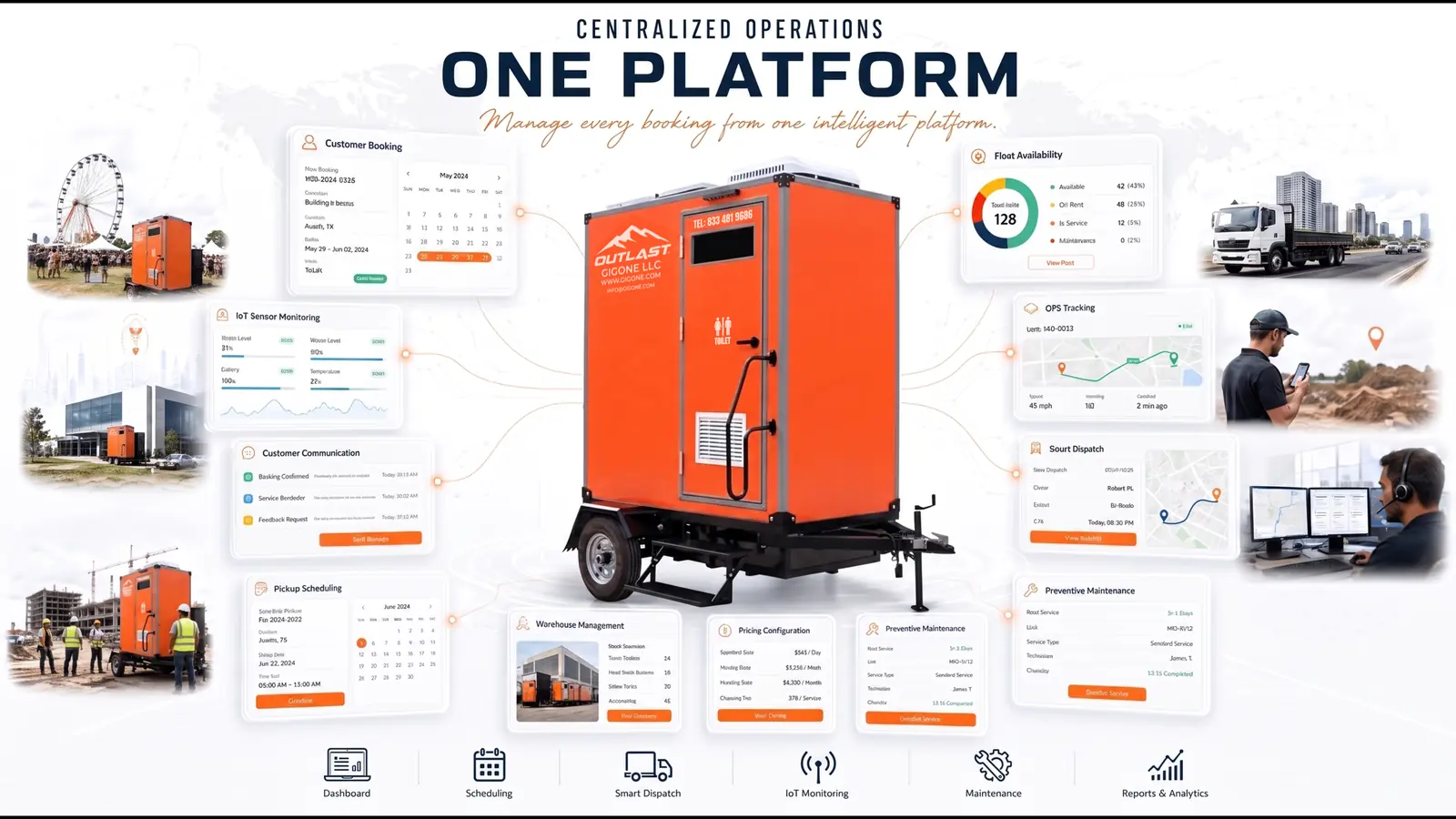
Asset tracking is not an isolated function. It is the data foundation that powers every other module in the GIG1 FLEET MANAGEMENT PLATFORM:
Asset tracking → IoT monitoring. Every sensor is linked to a specific asset. When a water level sensor reports “50%,” the system knows which unit, which model, which tank size, and which location enabling precise service decisions. Without asset tracking, sensor data is just numbers without context. For the complete sensor deep-dive, see IoT Restroom Monitoring: How Smart Sensors Track Water, Waste & Location.
Asset tracking → Maintenance. A unit’s service history stored in its asset profile determines when the next maintenance is due. Model-specific requirements (anti-freeze maintenance for Premium models, emergency discharge testing for C-1P Professional) are tied to the asset’s product type. When a maintenance job is completed, the asset’s history updates automatically. For the full maintenance workflow, see Portable Restroom Maintenance Software.
Asset tracking → Booking. The booking system checks asset availability in real time. If a unit is under maintenance, its status automatically prevents it from appearing as available for rental eliminating double bookings. When a rental ends and the unit returns to “Available” status, it immediately becomes bookable again. For the complete booking process, see Portable Restroom Rental Management.
Asset tracking → Analytics. Fleet utilization rate rented hours divided by total available hours is calculated per unit, per model, per warehouse, and per city. Revenue per unit, maintenance cost per unit, and customer satisfaction per deployment all flow from the asset record. Without granular asset data, analytics would be fleet-level averages that hide the variance between high-performing and underperforming units. For strategic analytics use cases, see Restroom Rental Business Analytics.
Conclusion
Portable restroom asset tracking is not a feature it is the foundation. Every operational improvement that matters to a portable sanitation operator predictive maintenance, real-time monitoring, efficient booking, data-driven growth depends on knowing exactly which units exist, where they are, what condition they are in, and what they have done.
The four-layer approach Identity, Location, Status, History transforms a fleet of anonymous boxes into a portfolio of data-rich assets. Each layer adds precision. Identity eliminates confusion. Location eliminates searching. Status eliminates guessing. History eliminates gut-feeling decisions.
In the GIG1 FLEET MANAGEMENT PLATFORM ecosystem, asset tracking serves as the connective tissue between every other module. Sensor data means nothing without knowing which asset the sensor belongs to. Maintenance workflows depend on knowing a unit’s service history and model-specific requirements. Booking availability depends on real-time status. Analytics depend on per-unit performance data accumulated over time.
For operators managing 20, 50, or 100+ portable restroom units across multiple cities and warehouses, the question is not whether asset tracking is worth the investment it is how much the absence of tracking is already costing them.
To see how asset tracking connects to the broader smart restroom platform, see What Is a Smart Restroom Management Platform?. And to understand how sensor data enriches asset profiles with real-time monitoring, see IoT Restroom Monitoring: How Smart Sensors Track Water, Waste & Location.
Frequently Asked Questions
Why does portable restroom asset tracking matter?
Equipment loss and misplacement cost operators thousands of dollars annually in idle capital, replacement purchases, and wasted labor. Asset tracking provides visibility into every unit’s identity, location, status, and service history transforming a fleet from a collection of anonymous units into a managed portfolio where every asset is accounted for.
What is an Asset ID and how does it work?
An Asset ID is a unique system-generated identifier assigned to each physical unit when it is registered in the platform. In GIG1 FLEET MANAGEMENT PLATFORM, the format is #AST-YYYYMMDD-XXXXXX sortable by registration date and searchable across the entire fleet. It works alongside the VIN and serial number to create a triple-verification identity system.
What is a VIN and why does it matter for portable restrooms?
A Vehicle Identification Number is required by the Department of Transportation for trailer-mounted units which includes all Gigone portable restrooms. The VIN proves legal ownership, enables NHTSA database verification, and satisfies DMV registration requirements for legal road transport between job sites and warehouses.
How does GPS tracking prevent equipment loss?
GPS sensors transmit each unit’s real-time coordinates to the platform dashboard. If a unit is moved outside an expected location without authorization, the system flags it for investigation immediately not weeks later during a physical inventory count. GPS also enables efficient retrieval at the end of rental periods and optimal route planning for maintenance technicians.
Can asset tracking data be exported for audits or reporting?
Yes. GIG1 FLEET MANAGEMENT PLATFORM’s analytics module supports export to Excel and CSV formats. VIN records, service histories, compliance documentation, and utilization reports are all stored digitally in each unit’s asset profile searchable and exportable in seconds rather than hours of filing cabinet searches.