

Executive Summary for Fleet Directors
For portable sanitation fleet operators, equipment material choice directly affects lifecycle cost, service efficiency, durability, and long‑term return on investment. While HDPE units offer a lower initial purchase price, composite structures provide superior dimensional stability, durability, and long‑term hygiene performance. Over extended fleet lifecycles, this can significantly improve Total Cost of Ownership (TCO).
Operational Impact for Rental Fleet Companies
Fleet operators typically evaluate sanitation equipment based on four operational metrics: durability, transport reliability, cleaning efficiency, and long‑term asset lifespan. Composite materials improve performance across these categories by reducing deformation, minimizing odor absorption, and maintaining structural stability during repeated transport cycles.
Lifecycle Cost Analysis (Illustrative)
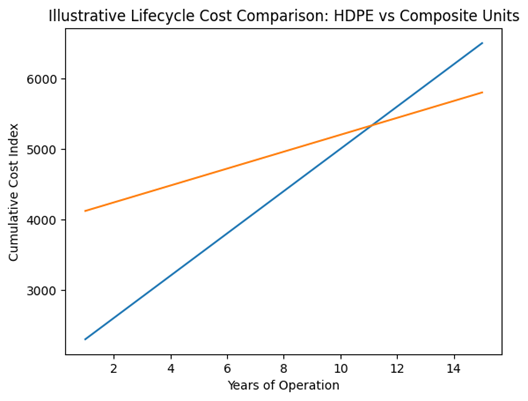
The following chart illustrates a simplified lifecycle cost comparison between HDPE and composite portable sanitation units over a 15‑year operational horizon. While HDPE systems often have lower initial costs, replacement cycles and maintenance can significantly increase cumulative expenses.
Key Economic Drivers
1. Replacement Cycle: HDPE units often require replacement within 3–7 years.
2. Structural Stability: Composite materials maintain dimensional integrity longer under transport stress.
3. Hygiene Performance: Non‑porous composite surfaces reduce odor retention and cleaning time.
4. Long‑Term ROI: Extended lifespan allows operators to amortize equipment costs across more rental cycles.
Technical Comparison Matrix
| Metric | HDPE | Advanced Composite (FRP) |
| Material Type | Thermoplastic | Thermoset Composite |
| Structural Stability | Moderate | High |
| UV Resistance | Moderate | High |
| Surface Porosity | Higher over time | Low |
| Operational Lifespan | 3–7 Years | 10–15 Years |
| Lifecycle ROI | Lower | Higher |
Strategic Implications for Sanitation Providers
For large sanitation providers operating hundreds or thousands of portable restroom units, material science decisions influence long‑term operational efficiency. Composite‑based sanitation systems can improve fleet durability, reduce maintenance downtime, and align with modern ESG (Environmental, Social, and Governance) operational standards.
Gigone — Engineering the Next Generation of Portable Sanitation Systems.


Leave a Reply
You must be logged in to post a comment.