



Compliance · VIN
VIN Certified Restroom Trailers
A valid VIN and Vehicle ID Plate make a trailer registrable, insurable, and resellable verifiable on the official NHTSA decoder.
DOT · VIN · DMV · EPA · 100+ mph · Made for the USA
Answer-first: A VIN certified restroom trailer carries a unique 17-character Vehicle Identification Number and a Vehicle ID Plate the identity that makes the unit registrable, insurable, financeable, and resellable. Without a valid VIN, a trailer often cannot be titled, plated, or insured. GIGONE builds every Mobile Oasis™ trailer with a Vehicle ID Plate so the unit has a traceable identity, and any U.S. VIN can be verified on the official NHTSA decoder.
The VIN is the single most important piece of identity a restroom trailer carries. It is what tells a state, an insurer, a lender, and a future buyer that the unit is a real, traceable vehicle rather than an unidentified piece of equipment. For procurement teams, “no VIN” is usually a disqualifying finding.
What a VIN does across the ownership lifecycle
- Ownership verification the VIN ties the trailer to a title and an owner of record, establishing clear, provable ownership.
- Registration state DMVs use the VIN to title and register the trailer. No VIN typically means no registration.
- Insurance & financing lenders and insurers reference the VIN; it is frequently a prerequisite for both coverage and capital.
- Resale value a VIN-certified trailer can be retitled and resold through normal channels; a unit without one is difficult to resell, transfer, or finance.
How GIGONE builds VIN-traceable trailers
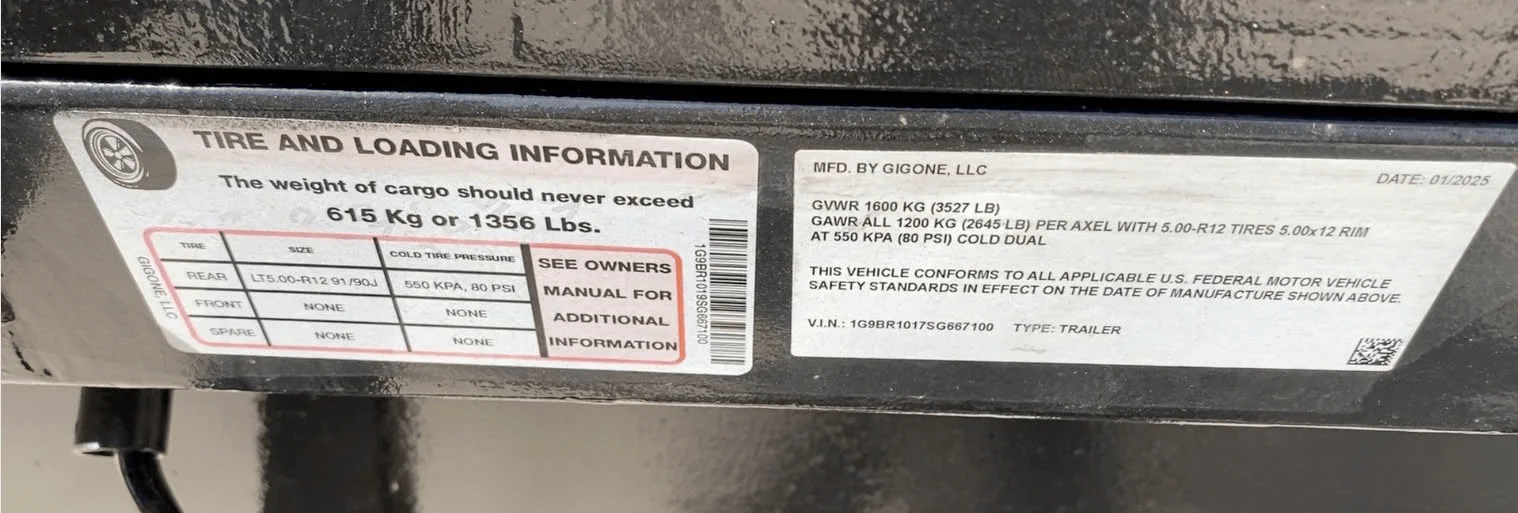
GIGONE produces each Mobile Oasis™ unit with a Vehicle ID Plate, giving every trailer a traceable identity that can be verified and titled. This is part of the standard build not an after-import retrofit. Because GIGONE is an accountable manufacturer rather than an anonymous importer, the identity behind each unit is something a buyer can trace and a future owner can rely on.
How to verify a restroom trailer VIN
Any U.S. VIN can be checked through the official NHTSA decoder maintained by the National Highway Traffic Safety Administration:
- Locate the 17-character VIN on the Vehicle ID Plate.
- Go to the NHTSA VIN decoder.
- Enter the VIN and confirm it decodes to a valid record.
If a VIN is missing, fewer than 17 characters, or fails to decode, treat it as a serious warning sign. For a full walkthrough, see our guide on how to verify a restroom trailer VIN.
VIN present vs. VIN missing
| Factor | VIN certified | No valid VIN |
|---|---|---|
| Decodes on NHTSA | Yes | No |
| DMV registration | Possible | Usually impossible |
| Insurability | Insurable | Frequently uninsurable |
| Financing | Eligible | Difficult |
| Resale | Retitle-able | Hard to resell |
Related compliance standards
- DOT compliant restroom trailers road and tow safety construction.
- DMV registration for restroom trailers how the VIN turns into a title and plate.
- Road-legal restroom trailers VIN combined with DOT and DMV for legal road use.
- Back to the restroom trailer compliance hub.
Frequently asked questions
Why does a restroom trailer need a VIN?
A VIN is the trailer’s unique identity. It is required to title and register the unit with a state DMV, to insure it, and to finance or resell it. A trailer without a valid VIN often cannot be registered or insured and is difficult to resell. Verify any U.S. VIN through the NHTSA decoder at vpic.nhtsa.dot.gov/decoder.
Do GIGONE restroom trailers come with a VIN and Vehicle ID Plate?
Yes. GIGONE produces each Mobile Oasis™ trailer with a Vehicle ID Plate, giving the unit a traceable identity that can be verified and titled. Buyers can confirm the VIN on the official NHTSA decoder before purchase.
How do I check if a restroom trailer VIN is valid?
Enter the 17-character VIN into the NHTSA decoder at vpic.nhtsa.dot.gov/decoder. A valid VIN decodes to a record; a missing, short, or undecodable number is a warning sign that the unit may not be registrable or insurable.
Can I insure a restroom trailer without a VIN?
Usually not. Insurers and commercial fleet policies typically require a VIN and proof of road-legal construction. No VIN often means no coverage or a denied claim after the fact.