

The portable sanitation industry in the United States generates billions in annual revenue and continues to grow as demand increases across construction, outdoor events, disaster relief, and municipal projects. Industry research from IBISWorld estimates the portable toilet rental market at over $3 billion, making it one of the fastest-evolving segments in field services. Yet despite this growth, the majority of portable restroom businesses still rely on spreadsheets, phone calls, and paper-based processes to manage their operations.
These are the same portable restroom management problems that operators faced a decade ago and they are becoming more expensive to ignore every year.
As fleets grow larger and customer expectations rise, the gap between how operators run their businesses and how they should run them is widening. Double bookings, lost equipment, maintenance delays, and zero visibility into fleet performance are not occasional inconveniences. They are systemic problems that cost money, damage reputations, and limit growth. It is one of the reasons why operators are increasingly exploring smart restroom management platforms such as Gig1, developed by Gigone to bring visibility, automation, and data into their daily operations.
This article examines the five most common operational problems in the portable restroom industry, why traditional approaches no longer work at scale, and what the shift toward smart restroom operations looks like in practice.
Table of Contents
The Reality of Portable Restroom Operations Today
Most portable restroom rental businesses started small. An owner with a truck, a handful of units, and a phone. Orders came in by call or email. Delivery schedules lived on a whiteboard or in a notebook. Maintenance happened when something broke.
That approach worked when the fleet had 10 units serving one county. It does not work when the fleet has 50 units serving multiple cities across state lines. Many of these issues are exactly what portable restroom fleet management is designed to solve.
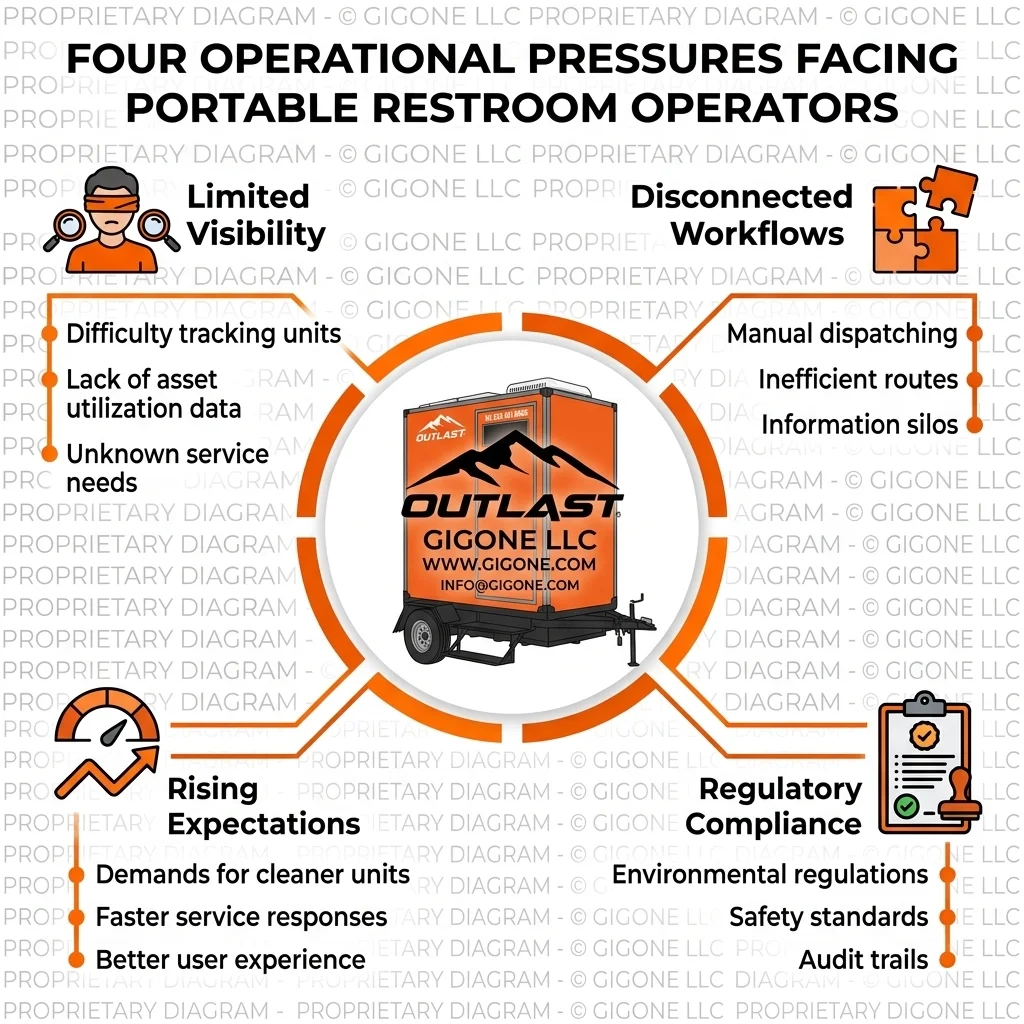
Today, operators face four converging pressures:
Limited visibility. Without GPS tracking or a digital asset registry, operators often cannot answer a basic question: Where is unit #37 right now, and what condition is it in?
Disconnected workflows. Booking, dispatch, maintenance, and invoicing often live in separate systems or in no system at all. A maintenance request on a unit that was just booked for delivery tomorrow creates a conflict no one catches until it is too late.
Rising customer expectations. Event organizers, construction site managers, and facility operators increasingly expect real-time updates, clean and well-maintained units, and professional communication. A missed delivery or a dirty restroom doesn’t just lose one job it loses future referrals.
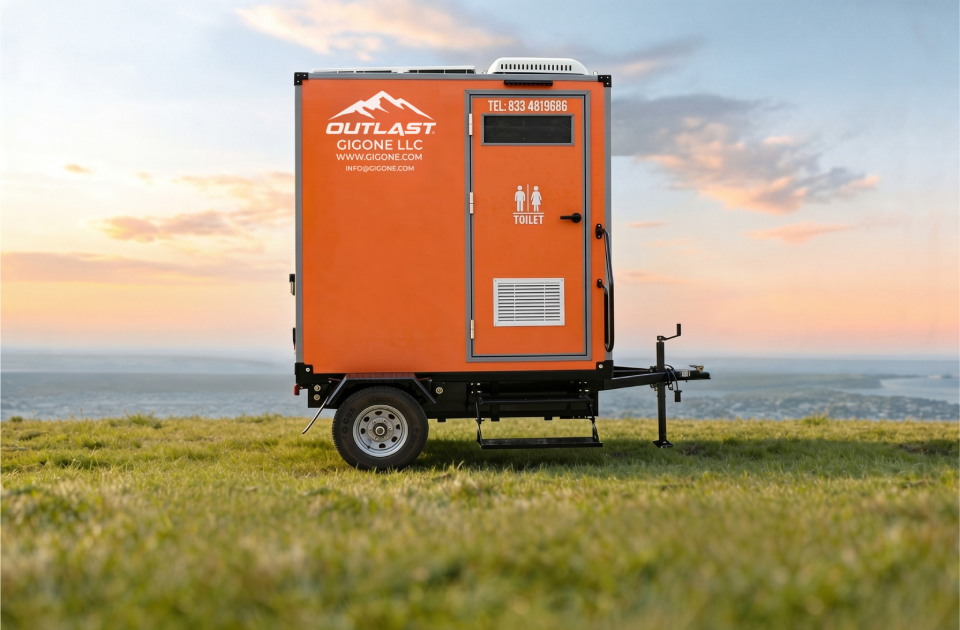
Regulatory compliance. Trailer-mounted portable restrooms are subject to DOT regulations, require valid VIN registration through NHTSA, and must comply with EPA waste handling standards. Paper-based tracking creates audit risk.
These pressures define the portable restroom operations challenges that operators across the country are confronting. The following five problems are the most common and the most costly.
Problem 1: Equipment Goes Missing
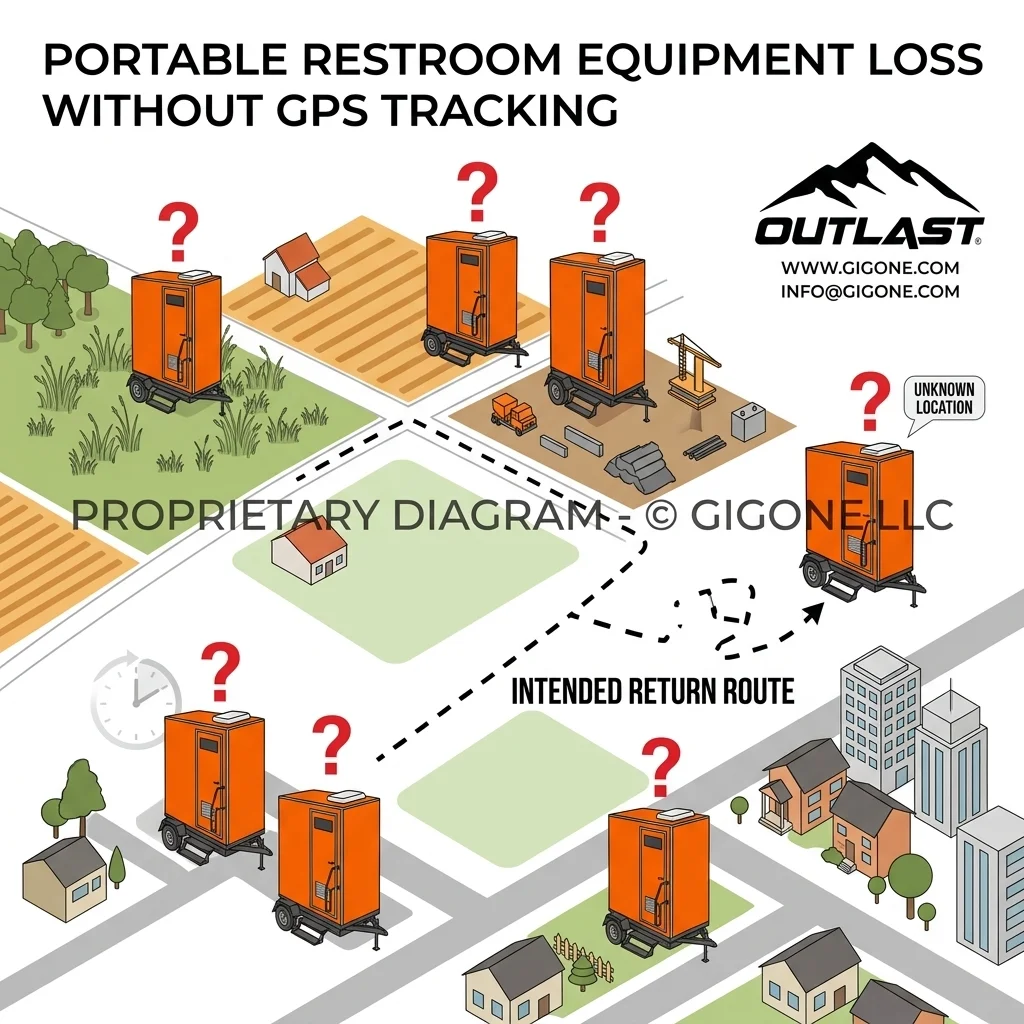
For most operators, the first sign of an asset management failure is not a notification. It is the realization that a unit that should be in the yard is simply not there.
Portable restrooms are deployed across job sites, event venues, parks, and construction zones often in locations without permanent infrastructure. Without GPS tracking or a centralized digital asset registry, operators rely on memory, spreadsheets, and phone calls to track where each unit is located. A digital approach to portable restroom asset tracking closes this gap.
The consequences are predictable:
- Units are moved between sites without documentation. A crew relocates a unit to cover a last-minute request. No one updates the spreadsheet. The next day, another crew shows up at the original location to service a unit that is no longer there.
- Asset confusion across job sites. When multiple units of the same model are deployed in the same area, it becomes difficult to track which specific unit was serviced, which needs maintenance, and which is scheduled for pickup.
- Lost units go unnoticed for weeks. Without a systematic inventory process, a missing unit may not be detected until a customer calls to report that their rental was never picked up or until the next physical audit reveals a gap.
The Portable Sanitation Association International (PSAI) has noted that equipment tracking and inventory management are persistent challenges for operators, particularly as fleets scale beyond a single depot. Every lost or misplaced unit represents both a direct asset cost and lost rental revenue for every day it sits untracked.
Problem 2: Maintenance Is Always Reactive
In the portable sanitation industry, the most expensive service call is the one you did not plan for.
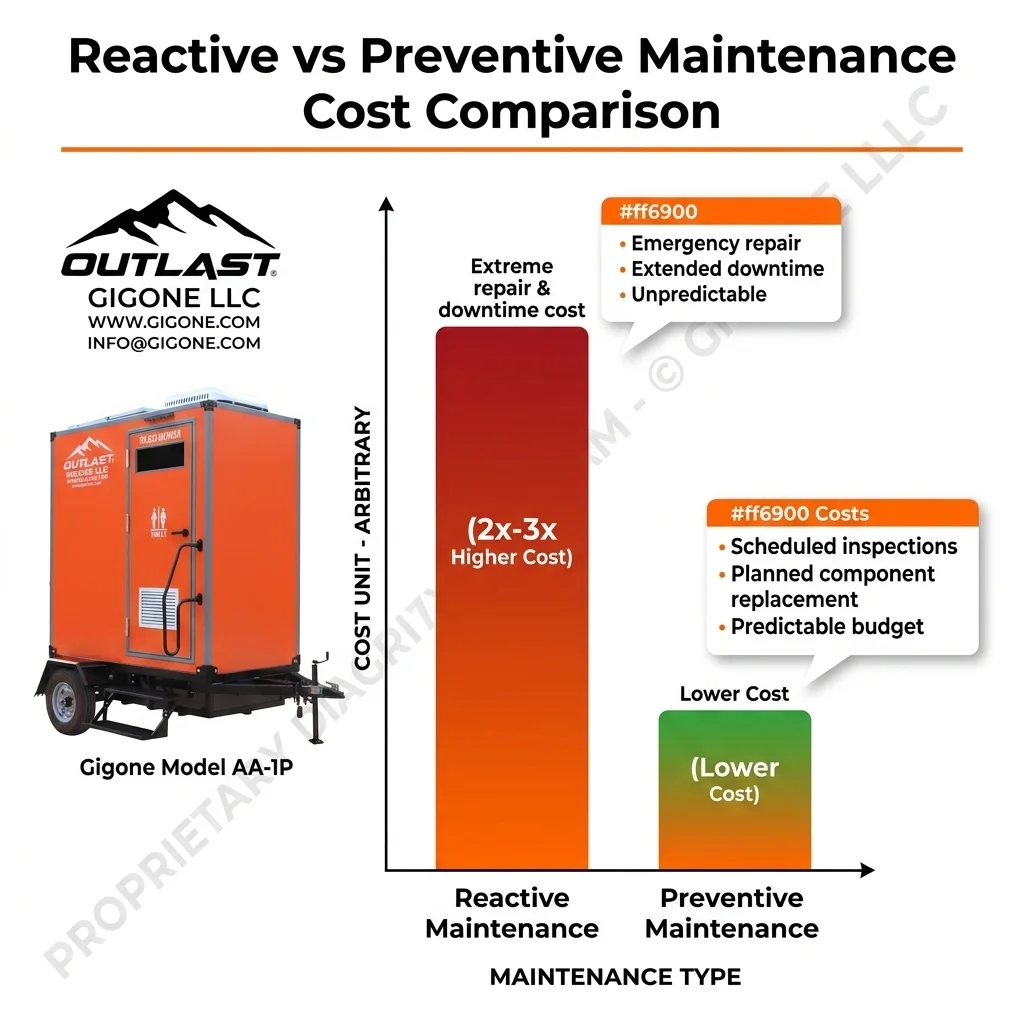
Reactive maintenance fixing equipment only after it breaks or a customer complains remains the default operating mode for most businesses. The reasons are straightforward: without real-time data on water levels, waste tank capacity, or equipment condition, operators have no way to know which units need attention until a technician physically inspects them or a customer reports a problem. This is exactly the blind spot that IoT sensors in the portable sanitation industry are closing, and what dedicated portable restroom maintenance software is built to automate.
This creates a costly cycle:
- Emergency repairs cost more. Unplanned dispatch requires last-minute scheduling, emergency parts sourcing, and often premium labor rates. Industry studies suggest that reactive maintenance can cost two to three times more than structured preventive maintenance programs, depending on fleet size and geographic spread.
- Downtime reduces rental revenue. A unit pulled out of service for emergency repair is a unit that cannot generate rental income. For operators running at high utilization rates, every hour of unplanned downtime is measurable lost revenue.
- Customer experience suffers. A restroom that runs out of clean water, overflows, or has a broken flush system does not just create a service ticket it creates a customer who will not book again. In an industry where reputation drives referrals, portable toilet business inefficiency in maintenance has a compounding effect on revenue.
The shift from reactive to preventive and eventually predictive maintenance is one of the most significant opportunities for portable restroom operators. But it requires data that manual operations simply cannot provide.
Problem 3: Scheduling and Booking Chaos
Ask any portable restroom operator what keeps them up at night, and scheduling is almost always in the top three.
The booking process at most businesses works like this: a customer calls or emails to request units. Someone checks a spreadsheet or calendar to see if those units are available. If they are, the booking is recorded manually. A driver is assigned usually by phone or text. Delivery happens. Hopefully.
The failure points in this workflow are numerous:
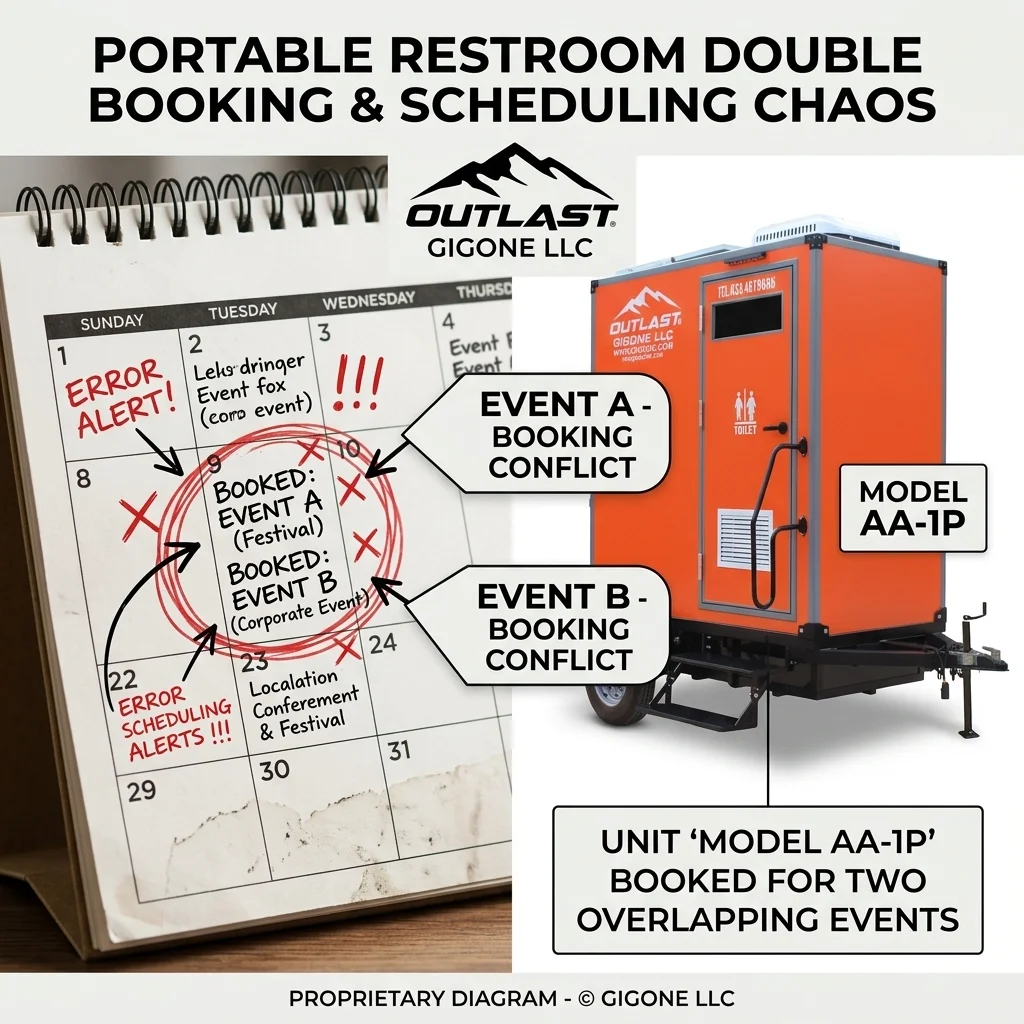
- Double bookings. Two customers are promised the same unit for the same date. Neither is told until delivery day, when one of them is left without service. According to PSAI, scheduling conflicts during peak season particularly around major holidays and event weekends represent one of the most common customer complaints in portable sanitation.
- Missed deliveries. A booking is recorded but never communicated to the dispatch team. Or it is communicated, but the driver’s route was already planned and the new stop was never added. The customer waits. The unit never arrives.
- Cancellation gaps. A customer cancels, but the unit is not made available in the system. It sits idle while other customers are told that nothing is available.
- Communication failures. The customer confirms a delivery time. The driver shows up at a different time. Or the customer changes the location but the update never reaches the driver.
Each of these failures is individually small. Collectively, they represent one of the most persistent portable restroom scheduling problems in the industry and one of the hardest to solve with manual processes.
Problem 4: No Operational Data to Guide Decisions
Growth in the portable restroom industry has historically been driven by intuition. An operator sees demand increasing in a neighboring county and buys more units. A new model seems popular, so they order a batch. A competitor opens nearby, so they lower prices.
None of these decisions are informed by data because most operators do not have data to inform them.
Without analytics, operators cannot answer fundamental business questions:
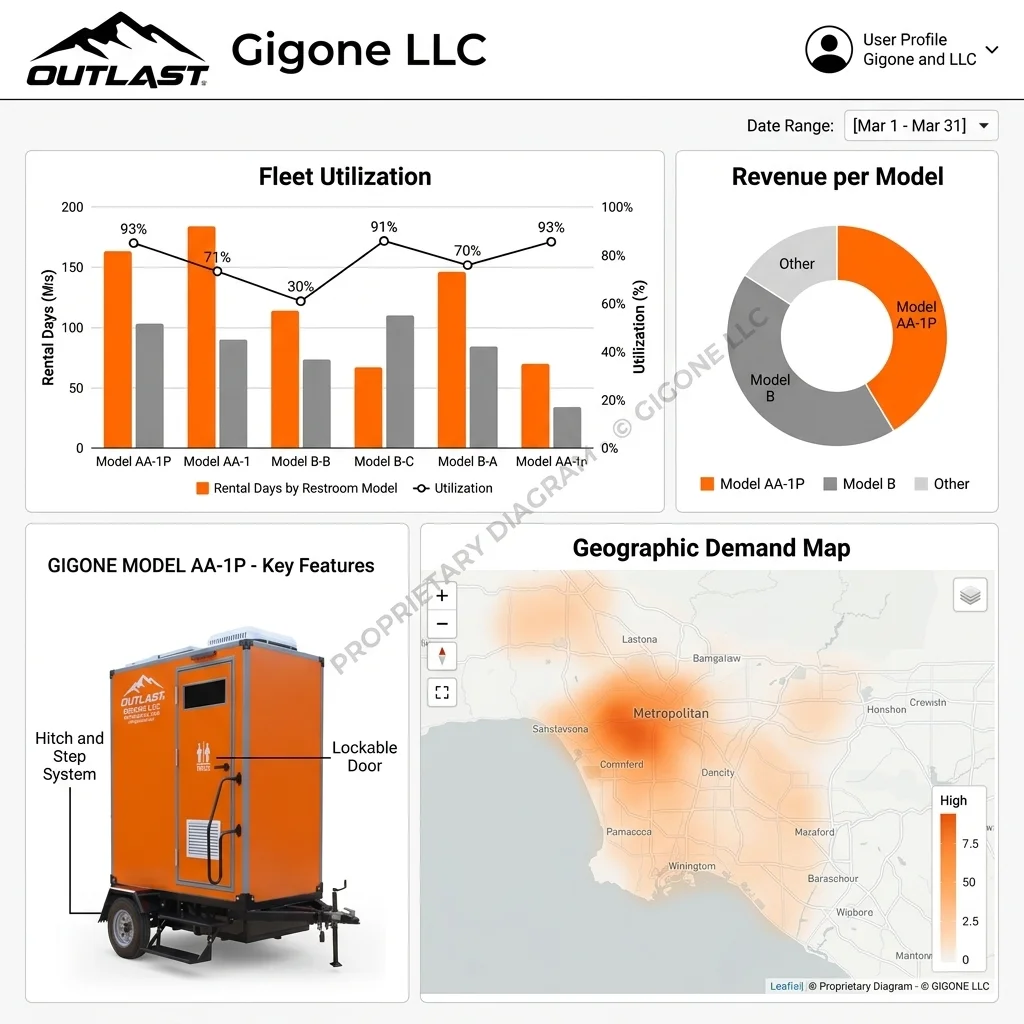
- Which models are most profitable? An operator may own both premium and standard units but have no way to compare revenue per unit, utilization rate, or maintenance cost per model.
- Which locations have the highest demand? Without booking data aggregated by geography, expansion decisions are based on anecdote rather than evidence.
- What is the fleet utilization rate? If an operator owns 50 units but only 30 are rented at any given time, the remaining 20 represent idle capital. Without tracking, this ratio is invisible.
- Are maintenance costs rising? Without per-unit service history, an operator cannot determine whether a specific unit has become a maintenance liability that should be retired.
The Small Business Administration (SBA) consistently identifies data-driven decision-making as a critical capability for small business growth. In the portable sanitation industry, the absence of operational data is not just an inconvenience it is a structural barrier to scaling efficiently.
Problem 5: Compliance and Documentation Risks
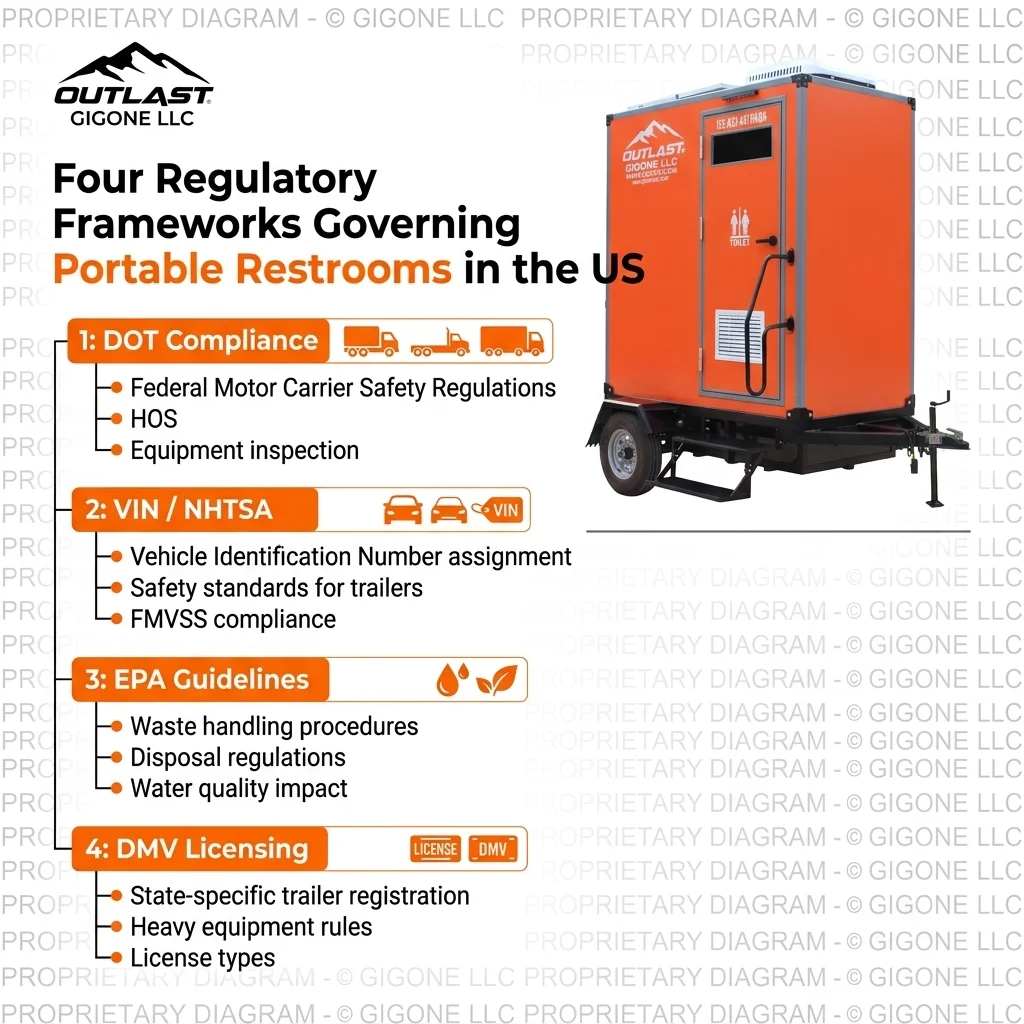
Portable restroom operations in the United States intersect with several regulatory frameworks that require accurate, current documentation.
DOT (Department of Transportation). Trailer-mounted portable restroom units that travel on public roads must comply with DOT trailer certification standards. This includes proper lighting, braking systems, and structural integrity requirements.
VIN (Vehicle Identification Number). Every trailer-mounted unit must be registered with a valid VIN through NHTSA. Operators can verify VIN data using the NHTSA VIN Decoder. Maintaining accurate VIN records is not optional it is a legal requirement for road transport.
EPA (Environmental Protection Agency). Waste handling, discharge, and disposal associated with portable sanitation must comply with EPA guidelines. Operators are responsible for proper waste treatment and documentation of disposal processes.
DMV (Department of Motor Vehicles). Vehicle registration and licensing requirements vary by state but consistently require current documentation for all towable equipment.
When these records are maintained on paper or in disconnected spreadsheets, the risk of errors, omissions, and audit failures increases significantly. A technician who services a unit but forgets to update the paper log creates a compliance gap that may not surface until an inspection or insurance claim.
Digital record-keeping does not eliminate compliance obligations but it makes them significantly easier to manage, track, and demonstrate during audits.
Why the Industry Is Moving Toward Smart Restroom Operations
The operational challenges described above are not unique to portable sanitation. Every field service industry has faced them and every one that has scaled successfully has solved them through technology.
Logistics and transportation transitioned from paper manifests and phone dispatch to digital fleet management platforms over the past two decades. Companies like fleet operators and freight carriers now rely on GPS tracking, automated routing, and real-time visibility as standard practice.
Construction has adopted project management software, digital permitting, and equipment tracking systems that replaced spreadsheets and clipboards.
Waste management has integrated route optimization, container-level monitoring, and automated scheduling into daily operations.
In each case, the transformation followed the same pattern: manual processes worked at small scale, created increasing problems at medium scale, and became unsustainable at large scale. The tipping point was not a single catastrophic failure it was the accumulation of daily inefficiencies that collectively consumed margin, damaged customer relationships, and limited growth.
The portable sanitation industry is reaching that same tipping point. But there is an additional dimension that sets this industry apart from general fleet management: the product itself is evolving.
Manufacturers are increasingly integrating sensors, connectivity, and operational software directly into restroom infrastructure. Water level monitoring, waste tank sensors, GPS tracking, and real-time alert systems are being built into units at the factory level not retrofitted as afterthoughts. This integration of hardware and software is creating a new category of equipment that goes beyond the traditional portable restroom.
The industry is not just digitizing its workflows. It is redefining what a portable restroom can be.
From Portable Restrooms to Smart Restrooms
For decades, a portable restroom was a static, passive piece of equipment. It was delivered. It sat. It was serviced on a schedule or when someone complained. It generated no data, sent no alerts, and provided no visibility between service visits.
That is changing.
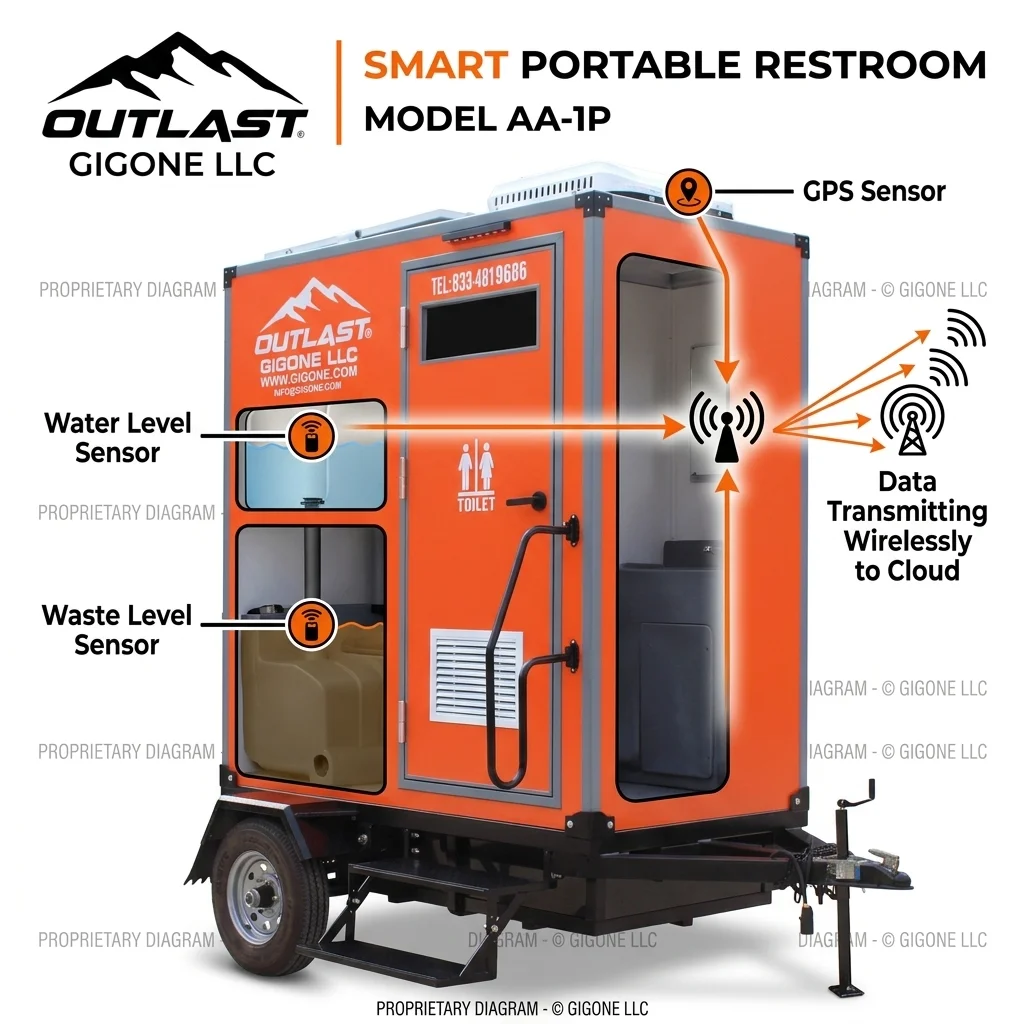
A smart restroom is a portable restroom unit equipped with integrated sensors, connectivity, and the ability to transmit operational data in real time. Instead of waiting for a technician to physically inspect a unit, a smart restroom reports its own status:
- Water level how much clean water remains before a refill is needed.
- Waste tank capacity how full the tank is, and when pump-out service should be dispatched.
- GPS location where the unit is right now, whether it has been moved, and how to route a technician to it.
- Equipment condition whether systems are functioning normally or triggering an alert.
This shift from passive equipment to connected, reporting infrastructure is what enables the transition from reactive operations to predictive ones. When a restroom can tell its operator that it needs service before a problem occurs, the entire operating model changes.
The concept of smart restrooms is still emerging, but the foundation is already being built by manufacturers who design both the hardware and the software ecosystems that manage them. Companies like Gigone are leading this shift by engineering sensor integration, IoT connectivity, and platform-based management into their product lines from the ground up rather than relying on third-party retrofits.
This is not a minor product enhancement. It is the beginning of a fundamental change in how portable sanitation assets are designed, deployed, monitored, and maintained.
The Emergence of Smart Restroom Management Platforms
The hardware alone is not enough. A sensor that reports water level data is only useful if there is a system to receive that data, interpret it, and trigger the right action.
This is why the industry is seeing the emergence of a new category of operational software: smart restroom management platforms. To understand the full picture, see our guide on what a smart restroom management platform is.
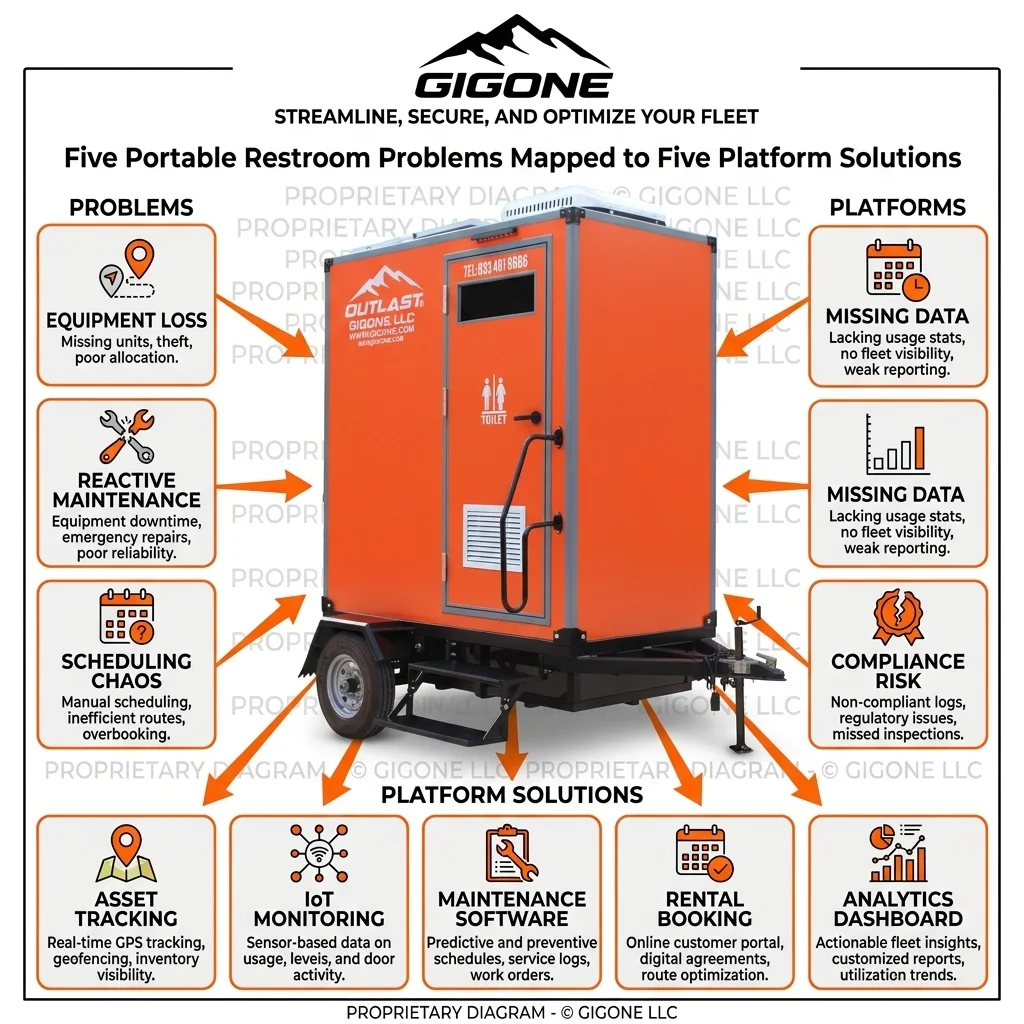
Unlike generic fleet management tools or disconnected scheduling apps, smart restroom management platforms are purpose-built for the portable sanitation industry. They integrate the capabilities that address each of the five problems described in this article:
- Asset tracking a digital registry with GPS location, VIN integration, and real-time status visibility for every unit in the fleet. Solves Problem 1.
- IoT monitoring connection to on-unit sensors that track water levels, waste tank capacity, and equipment location, providing actionable data without a physical inspection. Solves Problem 2.
- Maintenance management automated scheduling, route planning, and technician assignment that shifts operations from reactive to predictive. Solves Problem 2.
- Booking and rental management centralized scheduling that eliminates double bookings, automates customer communication, and manages delivery logistics. Solves Problem 3.
- Business analytics dashboards that provide utilization metrics, geographic demand analysis, and revenue reporting by model, location, and time period. Solves Problem 4.
- Digital compliance records VIN tracking, DOT documentation, EPA waste handling logs, and audit-ready reporting. Solves Problem 5.
Gig1, the smart restroom management platform developed by Gigone LLC, is one example of this new generation of purpose-built systems. Gig1 integrates asset management, IoT sensor monitoring, maintenance workflows, rental booking, and business analytics into a single platform designed specifically for Gigone’s portable restroom ecosystem.
What distinguishes platforms like Gig1 from generic software is the integration between hardware and software. When the same company manufactures the restroom units and builds the management platform, the sensors, data standards, maintenance protocols, and analytics are designed to work as a unified system not a collection of third-party tools stitched together.
The shift toward smart restroom management platforms is not about adopting technology for its own sake. It is about closing the operational gaps that manual processes cannot and building the data infrastructure that sustainable, scalable growth requires.
Conclusion
The five portable restroom management problems outlined in this article equipment loss, reactive maintenance, scheduling chaos, absent data, and compliance risk are not new. They have existed since the industry began.
What has changed is the cost of leaving them unresolved and the availability of solutions designed specifically to address them.
As fleets grow, customer expectations rise, and regulatory requirements tighten, the margin of error for manual operations shrinks. The spreadsheet that worked for 10 units becomes a liability at 50. The phone call that scheduled one delivery cannot coordinate 20 across three states. The paper log that tracked one warehouse cannot maintain compliance records across multiple depots.
The portable sanitation industry is following the same path that logistics, construction, and waste management have already traveled. But it is also going further evolving from passive portable restrooms to connected smart restrooms that generate data, trigger alerts, and enable predictive operations.
Operators who recognize these problems are not failing they are running businesses that have outgrown the tools they started with. The question is not whether to modernize, but how to evaluate the smart restroom management platforms that are emerging to solve these exact challenges.
The shift is already underway.
Frequently Asked Questions
Why is portable restroom management still done manually?
Most portable restroom businesses started as small, owner-operated companies where spreadsheets and phone calls were sufficient. Industry-specific software has only recently become available, and many operators have not yet evaluated digital alternatives because the problem grew gradually one missed booking or lost unit at a time.
What are the biggest costs of inefficient portable restroom operations?
The four most significant cost areas are: equipment loss and misplacement (direct asset costs plus lost rental revenue), reactive maintenance (two to three times more expensive than preventive programs), missed bookings due to scheduling conflicts (both lost revenue and damaged reputation), and labor waste from poor routing and manual communication.
How do operators prevent equipment loss in portable sanitation?
Prevention requires three capabilities: a digital asset registry that assigns a unique identifier (such as an Asset ID and VIN) to every unit, GPS tracking that provides real-time location visibility, and status tracking that shows whether each unit is available, deployed, in maintenance, or in transit. Paper-based systems cannot reliably deliver any of these.
What causes double bookings in portable restroom rental?
Double bookings typically occur when booking information exists in a single spreadsheet or calendar that is not updated in real time. When multiple people take bookings by phone, email, or in person the same unit can be promised to two customers for overlapping dates. Centralized booking systems with real-time availability checks eliminate this problem.
When should a portable restroom company adopt management software?
Most operators reach the tipping point when managing 20 or more units, operating across multiple geographic locations, or experiencing repeated revenue losses from scheduling errors, maintenance delays, or equipment tracking failures. Below that threshold, structured manual processes may suffice, but the transition becomes increasingly urgent as the fleet scales.




Leave a Reply
You must be logged in to post a comment.